
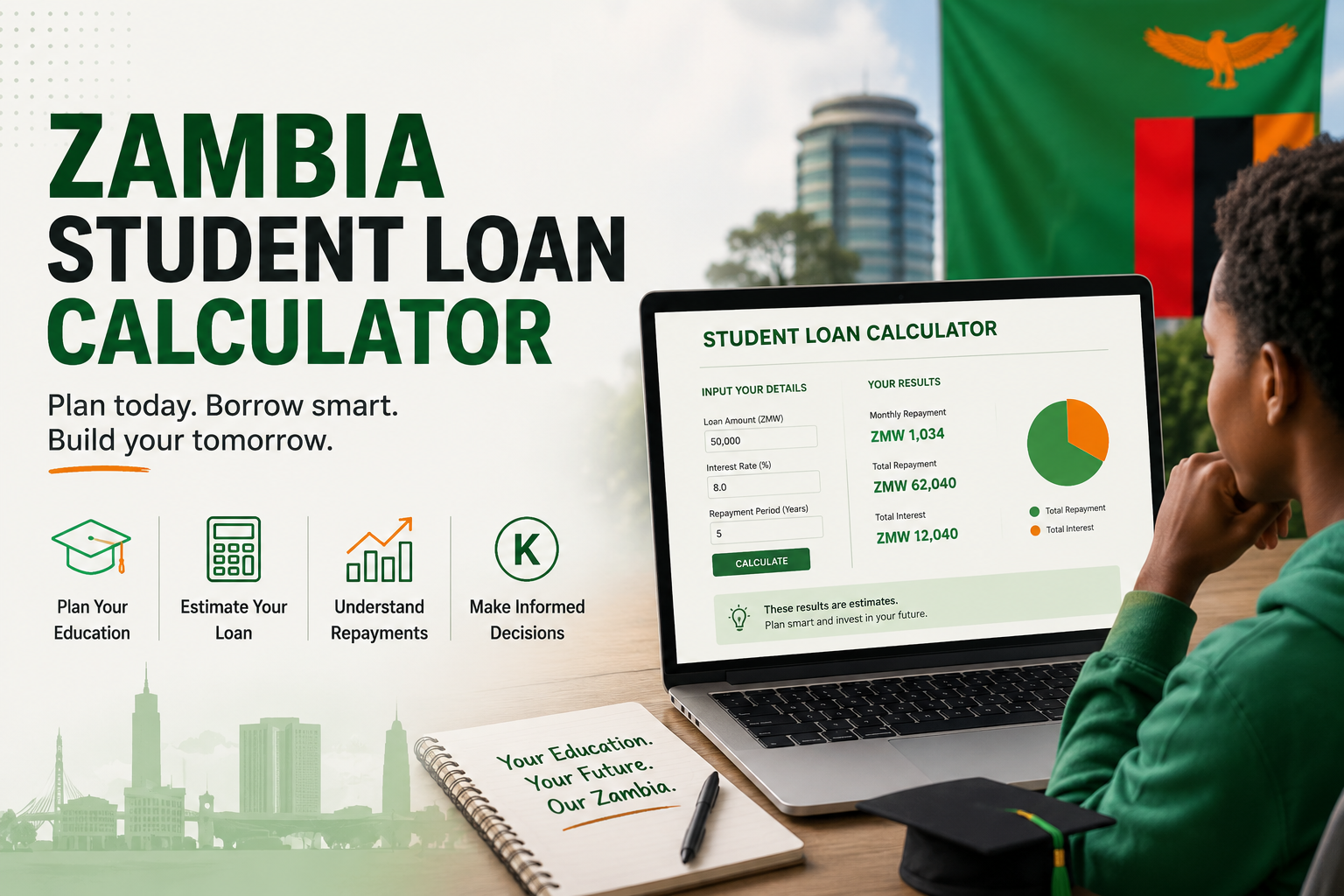
Zambia Student Loan Calculator
Student Finance
Student Loan
Calculator
Understand exactly what you owe, what you’ll pay each month, and how to escape debt faster — all in one place.
Borrowing money for college can feel abstract — until the first bill arrives. A student loan calculator transforms a wall of numbers into a clear repayment roadmap. Whether you’re evaluating how much to borrow before school, comparing federal and private offers, or hunting for ways to shave months off your payoff date, the interactive tool below does the heavy lifting for you.
This guide pairs the calculator with plain-language explanations of how student loan interest works, a breakdown of the main loan types, and actionable tips to cut your total repayment cost. Use the jump links above to move between sections at any time.
🎓 Student Loan Repayment Calculator
| Year | Principal Paid | Interest Paid | Balance |
|---|
How Student Loan Interest Works
Most student loans accrue interest daily using a process called simple daily interest. Your lender divides your annual rate by 365 (or 360, depending on the servicer) to get a daily rate, then multiplies that by your outstanding principal. Understanding this mechanic is the key to using the calculator above to its full potential.
The Capitalization Trap
During deferment, forbearance, or income-driven repayment periods, interest can accumulate without being paid. When that pause ends, unpaid interest is capitalized — added to your principal balance. You then pay interest on a larger number, which compounds your total cost significantly. This is one reason the calculator’s “Total Interest” figure can seem surprisingly high.
Grace Periods and When Interest Begins
Federal subsidized loans are interest-free while you’re enrolled at least half-time and during the six-month grace period after graduation. Unsubsidized and most private loans begin accruing interest from the moment funds are disbursed — meaning your balance grows while you’re still in school. Even small in-school payments, like $25 or $50 a month, can save hundreds in long-run interest costs.
Types of Student Loans
Not all student loans are created equal. The type of loan you carry determines your interest rate, repayment options, and forgiveness eligibility. Here’s a quick comparison:
| Loan Type | Interest (2025–26) | Subsidized? | Forgiveness Eligible |
|---|---|---|---|
| Federal Direct Subsidized | 6.53% | Yes | Yes |
| Federal Direct Unsubsidized (UG) | 6.53% | No | Yes |
| Federal Direct Unsubsidized (Grad) | 8.08% | No | Yes |
| Federal PLUS (Parent/Grad) | 9.08% | No | Limited |
| Private Loans | 4%–16%+ | No | No |
Federal vs. Private: Which Belongs in the Calculator?
Federal loans almost always offer superior protections — income-driven repayment, deferment, and potential forgiveness — that private loans can’t match. Use the calculator for both, but don’t refinance federal loans into private ones simply for a lower rate without weighing what benefits you’d permanently give up.
Choosing a Repayment Plan
Your monthly payment isn’t fixed in stone — especially for federal loans. The chart above illustrates how dramatically the plan you choose affects your monthly obligation and your long-term interest cost. Plug different payment amounts into the calculator to see your personal tradeoffs.
Standard Repayment (10 Years)
Fixed payments that clear your debt in exactly 10 years. You pay the least interest overall and qualify for the fewest complications. This is the default plan and the one most borrowers should benchmark against.
Graduated Repayment
Payments start low and rise every two years, designed for borrowers who expect their income to grow. The catch: because early payments are small, more of them go toward interest, meaning you pay more over the life of the loan than on the standard plan.
Income-Driven Repayment (IDR)
Plans like SAVE (Saving on a Valuable Education) cap monthly payments at a percentage of your discretionary income — sometimes as low as 5% for undergraduate loans. Any remaining balance is forgiven after 20–25 years. Ideal for borrowers with high debt relative to income, or those pursuing Public Service Loan Forgiveness (PSLF), which forgives balances after 10 years of qualifying payments.
💡 Which plan is right for you?
- Low debt, steady income: Standard 10-year plan. Lowest total cost.
- Just starting out, income will grow: Graduated plan, then refinance later.
- High debt or tight budget: SAVE IDR plan, consider PSLF if in public service.
- Private loans: Check refinancing options if your credit score improved.
Money-Saving Tips to Pay Off Faster
1. Make Biweekly Payments
Split your monthly payment in half and pay every two weeks. You’ll make 26 half-payments per year — equivalent to 13 full monthly payments — and reduce interest by attacking the principal more frequently. Use the extra payment field to model this effect.
2. Always Pay More Than the Minimum
Even $50 extra per month on a $35,000 balance at 6.54% saves roughly $1,800 in interest and cuts seven months off your repayment. The math is simple: extra dollars go directly toward principal, permanently reducing your interest base.
3. Apply Windfalls Strategically
Tax refunds, work bonuses, and gift money can make a dramatic impact when applied to principal. Contact your servicer to ensure lump-sum payments are applied to principal, not future payments — servicers are legally required to comply with this request.
4. Refinance — But Know the Risks
If your credit score has improved since origination and you hold private loans (or federal loans you don’t need income-driven protection on), refinancing to a lower rate can save thousands. Run both scenarios through the calculator before committing — the interest savings need to outweigh any origination fees.
5. Claim the Student Loan Interest Deduction
U.S. borrowers can deduct up to $2,500 of student loan interest paid per year from their taxable income, subject to income limits. This doesn’t lower your loan balance, but it reduces your annual tax bill — effectively cutting the real cost of your interest payments.
Frequently Asked Questions
How accurate is this student loan calculator?
The calculator uses the standard amortization formula to produce precise monthly payment, total interest, and payoff schedule figures. Results assume a fixed interest rate and do not account for rate adjustments on variable-rate loans or income-driven plan recalculations.
What is a good interest rate for a student loan?
For federal loans, the rate is set by Congress each year. For 2025–26, undergraduate rates sit at 6.53%. Private loan rates vary from around 4% to over 16% depending on your credit history; anything below the federal rate — with comparable protections — is generally worth considering.
Should I pay off student loans or invest?
If your loan rate is below roughly 6–7%, historical stock market returns suggest investing in a diversified index fund may outperform the guaranteed “return” of debt elimination. Above that rate, paying down debt becomes more compelling mathematically. Most financial planners recommend doing both simultaneously once you have a three-to-six-month emergency fund.
Can I use this calculator for parent PLUS loans?
Yes — enter the PLUS loan amount and current rate (9.08% for 2025–26) in the calculator above. Note that PLUS loans have fewer income-driven repayment options than standard Direct loans.