

Profit Calculator
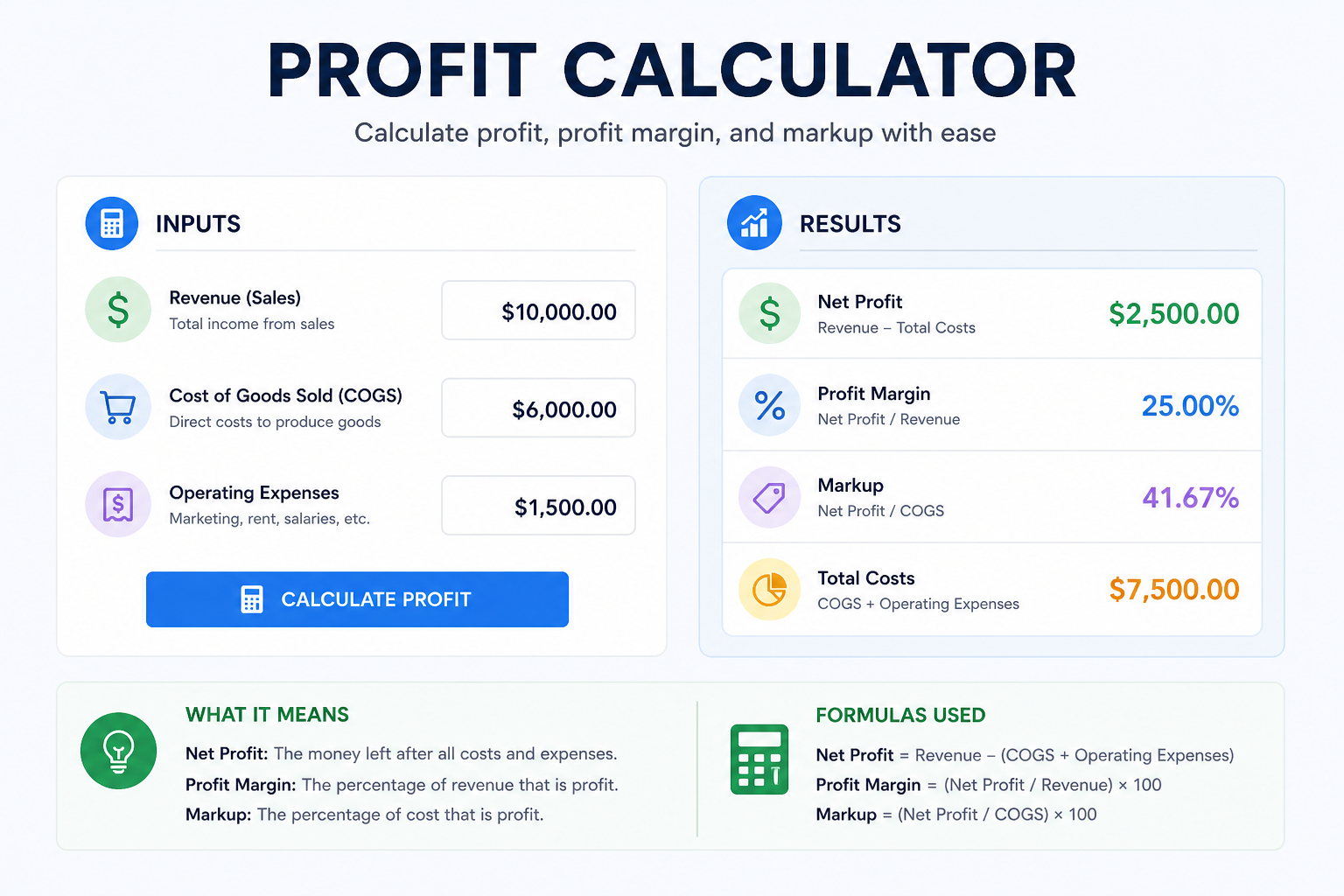
It helps you answer important questions like:
- Am I making a profit or loss?
- How much profit am I earning per sale?
- What price should I sell at?
🧮 Basic Profit Formula
Profit = Selling Price − Cost Price
- Selling Price (SP): The price you sell your product
- Cost Price (CP): The price you bought or produced the product
💵 Example Calculation
Let’s say:
- Cost Price = K100
- Selling Price = K150
Profit = 150 − 100 = K50
✅ You made a profit of K50
📉 Loss Formula
If you sell below cost:
Loss = Cost Price − Selling Price
Example:
- Cost Price = K100
- Selling Price = K80
Loss = 100 − 80 = K20
❌ You made a loss of K20
📈 Profit Percentage Formula
To understand how well your business is performing, use:
Profit % = (Profit ÷ Cost Price) × 100
Example:
- Profit = K50
- Cost Price = K100
Profit % = (50 ÷ 100) × 100 = 50%
📊 Margin vs Markup (Important!)
Many people confuse these two:
✔️ Markup
Markup % = (Profit ÷ Cost Price) × 100
✔️ Margin
Margin % = (Profit ÷ Selling Price) × 100
👉 Example:
- Cost Price = K100
- Selling Price = K150
- Profit = K50
- Markup = 50%
- Margin = 33.3%
🛠️ Why Use a Profit Calculator?
Using a profit calculator helps you:
✔ Set the right prices
✔ Avoid losses
✔ Track business performance
✔ Make better financial decisions
✔ Save time instead of manual calculations
The Simple Profit Formula Every Business Owner Should Know
Stop guessing. Start calculating. The one equation that separates thriving businesses from struggling ones — explained simply with real examples.
You can have a fully booked calendar, a bustling storefront, and a product people love — and still be losing money every month. Thousands of business owners discover this the hard way. The culprit? Not understanding profit.
At its core, profit is not complicated. But most business owners focus on revenue — the money coming in — while ignoring the forces quietly draining it. This guide cuts through the confusion and teaches you the simple profit formula, how to apply it in three different ways, and the exact strategies to make your number bigger.
Profit is what your business keeps after paying all its bills. Revenue is what it earns. Confusing the two is one of the most costly mistakes a business owner can make.
What Is the Profit Formula?
The foundation of business finance is elegantly simple. Every dollar your business brings in, minus every dollar it spends, equals your profit. Here it is:
Total Revenue includes all money your business earns — from product sales, services, subscriptions, consulting fees, and any other income stream.
Total Expenses include every cost to run the business: materials, rent, salaries, utilities, marketing, software, taxes, insurance, loan repayments — everything.
Many business owners use gross profit when they should be calculating net profit. Gross profit only subtracts production costs — not your rent, staff, or taxes. Net profit is your true bottom line. Always know both numbers.
The 3 Types of Profit You Must Know
Not all profit is created equal. Smart business owners track three different profit figures, each telling a different part of the story.
Gross Profit
Shows how efficiently you produce or deliver your product. High gross profit = strong pricing power.
Operating Profit
Reveals how well you run day-to-day operations, excluding interest and taxes. Great for benchmarking.
Net Profit
Your true “bottom line.” This is the money that’s actually yours — what you can reinvest or pay yourself.
Real-World Example: The Coffee Shop Calculation
Let’s walk through a practical example. Meet Sarah — she owns a local coffee shop that brings in $25,000 in monthly revenue. Here’s how she calculates each layer of profit:
Sarah earns $25,000 per month, but her actual profit — the money she can reinvest or pay herself — is $5,100. This is why knowing your full cost picture is critical, not just revenue.
How to Calculate Your Profit in 4 Simple Steps
Add Up All Revenue Sources
Include every income stream: product sales, service fees, subscriptions, digital downloads, consulting, and any other revenue. Use your accounting software or bank statements for accuracy.
Calculate Your Cost of Goods Sold (COGS)
These are the direct costs tied to producing what you sell — raw materials, manufacturing labor, packaging, shipping, and supplier fees. Subtract COGS from revenue to find your gross profit.
List All Operating Expenses
Rent, utilities, employee salaries, insurance, software subscriptions, marketing costs, and administrative expenses. Subtract these from your gross profit to find your operating profit.
Deduct Interest, Taxes & One-Off Costs
Subtract loan interest, tax obligations, and any non-recurring costs. The final number is your net profit — your true bottom line. Divide by revenue × 100 to get your profit margin percentage.
What’s a Good Profit Margin? Industry Benchmarks
Profit margins vary dramatically by industry. Knowing where you stand against your peers is essential for setting realistic targets and spotting problems early.
| Industry | Avg Gross Margin | Avg Net Margin | Difficulty |
|---|---|---|---|
| Software / SaaS | 70–85% | 15–25% | High |
| Professional Services | 60–75% | 15–20% | High |
| E-Commerce (Direct) | 40–60% | 10–20% | Medium |
| Retail (Brick & Mortar) | 30–50% | 2–8% | Medium |
| Restaurants / Food | 60–70% | 3–9% | Tight |
| Construction | 20–30% | 2–6% | Tight |
| Manufacturing | 25–40% | 5–12% | Medium |
A net profit margin of 10% is average, 20% is good, and 30%+ is excellent for most small businesses. Below 5% signals that your cost structure needs urgent attention.
6 Proven Ways to Boost Your Business Profit
The profit formula gives you a diagnosis. These strategies give you the cure. You can improve your bottom line by pulling on two levers: increasing revenue or decreasing costs.
💰 Raise Your Prices Strategically
A modest 5–10% price increase — without losing customers — can dramatically lift net margins. Most buyers are less price-sensitive than owners fear. Test it in one product line first.
✂️ Cut Low-Value Expenses
Audit every monthly subscription, vendor contract, and recurring cost. Cancel anything that doesn’t directly drive revenue or efficiency. Small leaks sink big ships.
📈 Upsell and Cross-Sell
Your existing customers are your cheapest revenue source. Adding a relevant upgrade or add-on product can increase average order value by 20–30% with zero extra acquisition cost.
🤝 Renegotiate Supplier Costs
Call your top 3 suppliers and ask for volume discounts, better payment terms, or competitive quotes. Reducing COGS by even 5% directly adds to your gross profit margin.
⚡ Automate Repetitive Tasks
Labor is often your largest expense. Use tools like Zapier, accounting software, and AI assistants to reduce manual hours and redirect your team’s time to higher-value work.
🔁 Focus on High-Margin Products
Analyze which products or services generate the most profit per sale — not just the most revenue. Shift your marketing and sales effort toward those offerings first.
Profit vs. Revenue: Why the Difference Matters
One of the most damaging myths in business is that “high revenue = high profit.” This simply isn’t true.
Business A — “Busy” Business
Business B — “Lean” Business
Same revenue. Business B keeps 12.5x more money. The difference? Cost discipline, pricing strategy, and a relentless focus on margin — not just topline growth.
🧮 Calculate Your Profit Right Now
Use our free Blog & Business Profit Calculator to estimate your monthly earnings, ad revenue, and net profit margin in under 60 seconds.
Try the Free Profit Calculator →❓ Frequently Asked Questions
What is the simplest profit formula?
What is the difference between gross profit and net profit?
What is a good profit margin for a small business?
How often should I calculate my business profit?
Is profit the same as cash flow?
How do I improve my profit margin without raising prices?
BusinessProfit Editorial Team
Our team of business finance writers, CPAs, and entrepreneurs creates actionable guides to help small business owners master their numbers, grow profit margins, and build lasting financial health. All content is fact-checked against current financial standards.