

The Short Answer: What’s the Difference?
Gross Salary
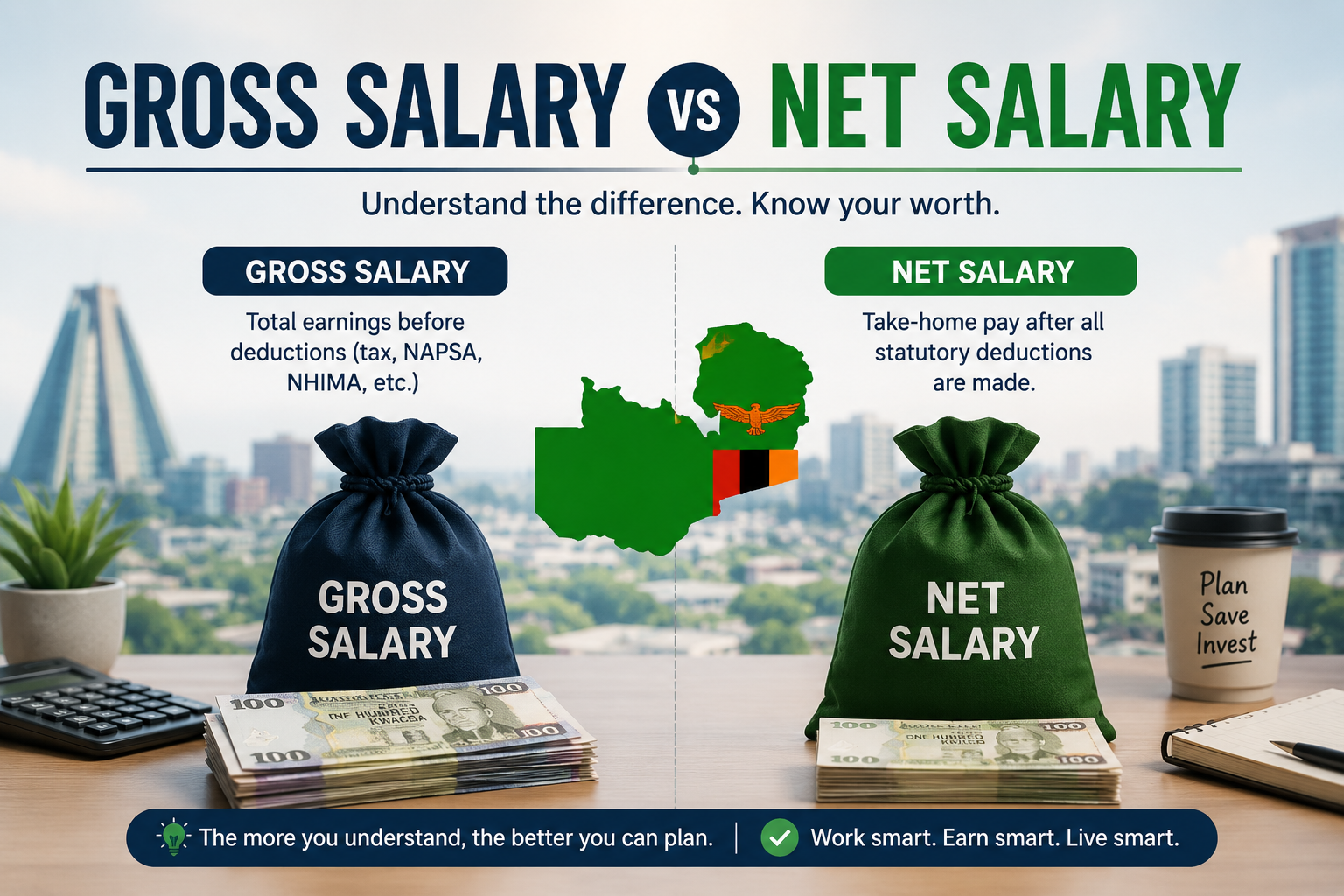
This is the total amount of money your employer agrees to pay you before any deductions are made. It’s the big, impressive number on your employment contract. It includes your basic salary, housing allowance, transport allowance, and any other regular benefits.
Net Pay (Take-Home Pay)
This is the actual amount of money that lands in your bank account at the end of the month. It is your Gross Salary minus all statutory (government-mandated) and voluntary deductions. This is the money you actually have to spend, save, or invest.
The Anatomy of a Zambian Payslip: Where Does the Money Go?
In Zambia, your employer is legally required to deduct certain amounts from your gross salary before paying you. These are called statutory deductions. Here is the exact order in which they are typically calculated:
| Deduction | Who gets it? | How much is it? |
|---|---|---|
| 1. NAPSA (National Pension Scheme Authority) |
Your future retirement fund | 5% of your basic salary. (Note: Capped at a maximum pensionable salary of K8,000, meaning the maximum monthly deduction is K400). |
| 2. NHIMA (National Health Insurance Management Authority) |
Public healthcare system | 1% of your gross emoluments. (Also capped at the K8,000 ceiling, so the maximum monthly deduction is K80). |
| 3. PAYE (Pay As You Earn) |
Zambia Revenue Authority (ZRA) | A progressive tax applied to your Chargeable Income (Gross minus NAPSA and NHIMA). Rates range from 0% to 37.5% depending on how much you earn. |
This is the magic number ZRA uses to calculate your tax. It’s your Gross Salary minus your NAPSA and NHIMA contributions. You are not taxed on the money you put into your pension or health insurance!
Let’s Look at a Real-Life Example
Numbers make more sense when we see them in action. Let’s imagine you’ve just been hired with a Gross Salary of K10,000 per month. Here is how your payslip breaks down:
Step 2: NAPSA Deduction = 5% of K8,000 (the ceiling) = K400
Step 3: NHIMA Deduction = 1% of K8,000 (the ceiling) = K80
Step 4: Calculate Chargeable Income = K10,000 – K400 – K80 = K9,520
Step 5: Calculate PAYE (Tax) on K9,520 using ZRA bands:
• First K5,100 @ 0% = K0
• Next K2,000 (from K5,101 to K7,100) @ 20% = K400
• Remaining K2,420 (from K7,101 to K9,520) @ 30% = K726
• Total PAYE = K0 + K400 + K726 = K1,126
Step 6: Calculate Net Pay
K10,000 (Gross) – K400 (NAPSA) – K80 (NHIMA) – K1,126 (PAYE) = K8,394
So, your Net Pay is K8,394. That’s the amount that will actually be deposited into your bank account.
Voluntary Deductions: The “Hidden” Extras
Sometimes, your net pay is even lower than the statutory math above. This is usually due to voluntary deductions that you agreed to. Common examples in Zambia include:
- Loan Repayments: Personal loans, bank loans, or employer-advanced loans.
- Union Dues: If you belong to a trade union (e.g., ZNUT, ZAMAWU), a small percentage is deducted monthly.
- Medical Aid: Private health insurance schemes (e.g., Madison, Cavmont, or corporate schemes).
- Savings Schemes: Company-sponsored savings or burial society contributions.
3 Tips for Managing Your Zambian Salary
- Negotiate in Gross, but Budget in Net: When discussing salary with a new employer, talk in Gross figures. But when planning your monthly rent, groceries, and transport, always base your budget on your estimated Net Pay.
- Keep Your NAPSA Number Safe: Ensure your employer is actually remitting your NAPSA and NHIMA deductions. You can check your contribution history by dialing the NAPSA USSD code or visiting their offices. Don’t let your employer “forget” to pay!
- Use a PAYE Calculator: Before accepting a job offer, plug the gross salary into a free online Zambian PAYE calculator. It will give you a highly accurate estimate of your take-home pay, so there are no unpleasant surprises on payday.
Frequently Asked Questions
Why is my Net Pay lower this month than last month?
This usually happens for a few reasons: you might have started repaying a new loan, your employer might have adjusted your tax code, or you received a one-time taxable bonus (which pushes you into a higher PAYE bracket for that specific month). Check your payslip line by line.
Does the employer also contribute to NAPSA and NHIMA?
Yes! This is free money for you. Your employer must contribute an additional 5% to NAPSA and 1% to NHIMA on your behalf. This does not come out of your gross salary; it is an extra cost borne by the company.
Are allowances (like housing or transport) taxed?
Yes. In Zambia, almost all cash allowances are considered part of your gross emoluments and are subject to NAPSA, NHIMA, and PAYE deductions. Only specific, non-cash benefits (like a company-provided car or housing, under certain conditions) might be treated differently, but cash is always taxed.
What happens if my employer doesn’t deduct PAYE?
If your employer fails to deduct and remit PAYE to the Zambia Revenue Authority (ZRA), the employer is legally liable for the unpaid tax, plus heavy penalties and interest. However, it’s always wise to keep your own records just in case.