


🎓 Quick ECZ Grade Calculator
Got your marks? Plug them in below to instantly see your ECZ grade and what it means for university.
| Marks You Got | Total Possible Marks |
| Subject Name (Optional) | |
Here is your result:
Understanding the ECZ Grading System (The 1 to 9 Scale)
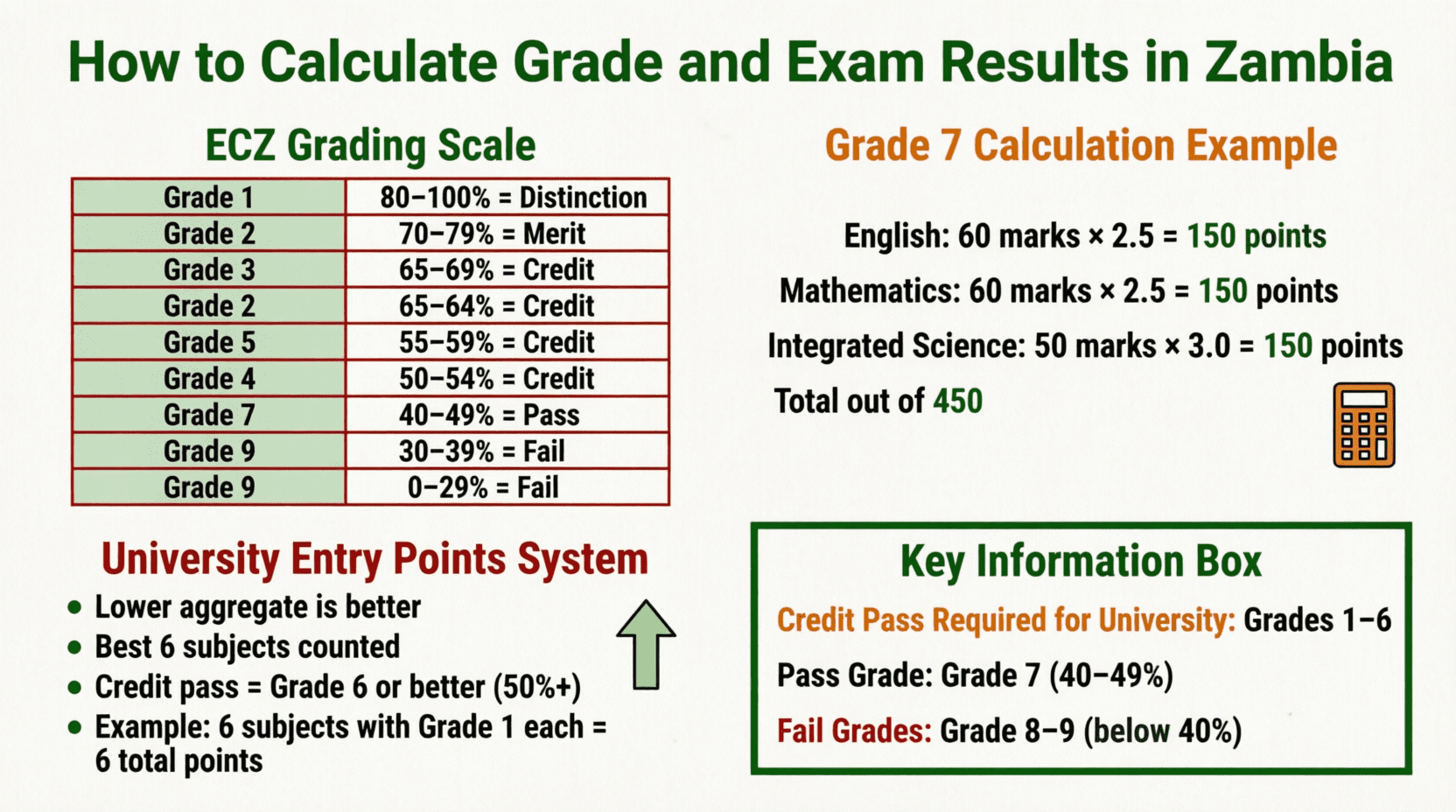
The Examinations Council of Zambia (ECZ) uses a straightforward 1-to-9 grading scale for Grade 7, 9, and 12 exams. Think of it like a leaderboard: Grade 1 is at the very top, and Grade 9 is at the bottom. Here is exactly how your percentage translates into that single-digit grade:
| ECZ Grade | Percentage Range | What it’s called | University Entry (Grade 12) |
|---|---|---|---|
| 1 | 80% – 100% | Distinction | ✓ Excellent. You’re in a great spot. |
| 2 | 70% – 79% | Merit | ✓ Very Good. Meets all requirements. |
| 3 | 60% – 69% | Credit | ✓ Good. The standard target for most degrees. |
| 4 | 50% – 59% | Pass | ⚠ Minimum Pass. Accepted for some programs, but competitive courses might want more. |
| 5 | 45% – 49% | Pass | ✗ Weak Pass. Usually not enough for a degree program. |
| 6 | 40% – 44% | Pass | ✗ Weak Pass. Not accepted for university degrees. |
| 7, 8, 9 | 0% – 39% | Fail | Fail. You will need to re-sit the exam. |
How to Calculate Your Grade (Step-by-Step)
Step 1: Find your raw marks
Look at your exam paper or slip. Find the total marks you actually scored, and the total marks that were possible. For most ECZ subjects, the total is 100. But if you took a subject with a practical part (like Science), the total might be 120 or 150.
Step 2: Do the quick math
Just divide what you got by the total possible, and multiply by 100. It looks like this:
Real-life example: You scored 72 out of 100 in English.
(72 ÷ 100) × 100 = 72%
Step 3: Check the table
Take that 72% and look at the table above. It falls right into the 70% – 79% bracket. That means you scored a Grade 2 (Merit). Simple as that!
The Secret to University Admission: The “Best 5” Rule
Getting good grades in your subjects is great, but it’s only half the battle. If you want to get into UNZA, CBU, or Mulungushi, you need to understand how they actually pick students. They don’t just look at your overall average; they use the “Best 5” rule.
What is the “Best 5” Rule?
Most degree programs require you to have at least five (5) passes at Grade 12. But there’s a catch—three of those five must be specific subjects:
- Mathematics: You usually need at least a Grade 3 (sometimes a 4 is okay for non-science courses).
- English Language: Again, usually a minimum of Grade 3.
- Three other subjects: These depend on what you want to study. Want to do Medicine? You’ll need Biology, Chemistry, and Physics. Want to do Business? You’ll need Accounting, Business Studies, and Economics.
How the “Aggregate Score” Works
For the really competitive programs (like Medicine at UNZA or Engineering at CBU), they calculate an “aggregate score”. They literally just add up the numbers of your best 5 subjects. Remember: a lower score is better here.
Mathematics: Grade 2
English: Grade 3
Biology: Grade 2
Chemistry: Grade 3
Physics: Grade 2
Aggregate Score = 2 + 3 + 2 + 3 + 2 = 12
(An aggregate of 12 is highly competitive and will get you noticed by top science programs).
Real Talk: Tips for Improving Your Results
- Past papers are your best friend: I’m not just saying that. ECZ frequently repeats question formats. Practicing the last 5 to 10 years of past papers is genuinely the most effective way to study.
- Show your working: Especially in Math and Science, ECZ gives out “method marks”. Even if your final answer is completely wrong, showing the correct steps can still earn you enough marks to bump you up a grade.
- Protect your Math and English grades: Since almost every post-secondary path requires these two, prioritize them. Getting a Grade 3 in Math and English keeps almost every door open for you.
- Read the syllabus: Download the official ECZ syllabus for your subject. It literally tells you what topics will be on the exam and how many marks they are worth. Study smart, not just hard.
Frequently Asked Questions
What happens if I get a Grade 5 or 6 in Math or English?
Technically, it’s a “Pass”, but most universities won’t accept it for a degree program. Don’t panic, though. You can “re-sit” (rewrite) the exam to improve your grade, or look into certificate and diploma programs at places like TEVETA-accredited colleges, which have more flexible entry requirements.
Can I combine Grade 12 results from different years?
Yes, you can! ECZ and Zambian universities generally allow you to combine results from a maximum of two sittings (for example, your 2025 and 2026 results) to meet the “Best 5” requirement. Just make sure the subjects match what the university program needs.
How are practical subjects graded?
Subjects with practicals (like Science or Agriculture) split the marks. You might get 80 marks for the written theory and 20 marks for the practical. ECZ combines these into one final score, which is then converted into your 1-to-9 grade.
What does “X” or “ABS” mean on my result slip?
“X” usually means there was an issue with exam malpractice, and the paper was canceled. “ABS” just means Absent—you didn’t sit for that specific paper. Both will count as a fail for that subject.