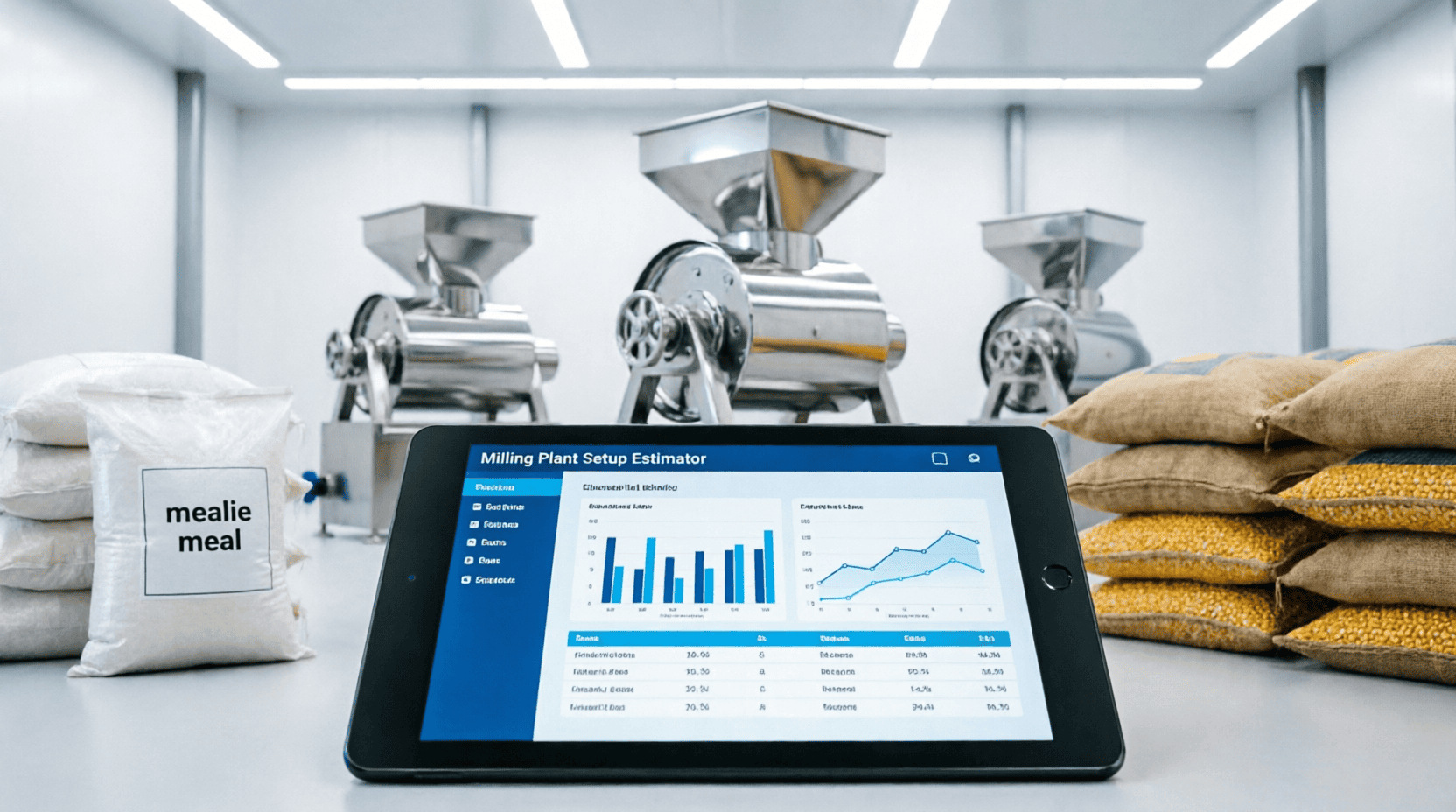
Milling Plant Setup Estimator
The Zambia Maize Milling Plant Setup Calculator helps entrepreneurs estimate the capital investment, operational costs, and potential profitability of starting a maize milling business. Whether you are planning a small-scale community hammer mill or a large-scale commercial roller mill producing branded mealie meal, this tool provides a comprehensive breakdown of machinery costs, ZESCO power requirements, raw material needs, and labor estimates based on current Zambian market conditions.
Milling Plant Setup Estimator
Estimate the initial investment required for machinery, infrastructure, and licensing.
| Plant Capacity (Tonnes/Hour) | Include Packaging Line? |
Calculate daily operational costs including maize purchase, electricity, and labor.
| Maize Price per Ton (ZMW) | Daily Production (Tons) | Electricity Rate (ZMW/kWh) |
Estimate monthly profit based on sales price and extraction rate (yield).
| Selling Price per 25kg Bag (ZMW) | Extraction Rate (%) | Daily Maize Input (Tons) |
About Maize Milling in Zambia
Maize milling is one of the most viable agribusiness opportunities in Zambia, given that maize is the staple food for the majority of the population. The primary product is mealie meal (breakfast meal or roller meal), while the by-product, maize bran, is highly valued in the livestock feed industry. Setting up a milling plant requires careful planning regarding location, power supply (ZESCO), and compliance with the Zambia Bureau of Standards (ZABS) for food safety.
Key Machinery Required
The type of machinery you need depends on your target market. Small-scale operations often use hammer mills, which are cheaper but produce lower-quality meal with higher bran content. Commercial operations use roller mills, which separate the germ and bran more effectively, producing high-quality white breakfast meal.
| Machine | Function | Estimated Cost (ZMW) |
|---|---|---|
| Cleaner/Destoner | Removes stones, dust, and chaff from raw maize. | K25,000 – K60,000 |
| Dampener/Conditioner | Adds moisture to maize to make bran separation easier. | K15,000 – K40,000 |
| Roller Mill / Hammer Mill | The core grinding unit. Roller mills are preferred for quality. | K150,000 – K600,000 |
| Sifter/Plansifter | Separates flour from bran and germ. | K40,000 – K120,000 |
| Packing Machine | Weighs and seals 25kg, 10kg, or 5kg bags. | K30,000 – K80,000 |
| Elevator/Conveyor | Transports grain between machines. | K20,000 – K50,000 |
Regulatory Compliance & Licensing
To operate legally and sell to supermarkets or institutions, your plant must meet several regulatory requirements:
- PACRA: Register your business name and incorporate your company.
- ZRA: Obtain a Taxpayer Identification Number (TPIN) and register for VAT if your turnover exceeds K800,000 annually.
- ZABS: Obtain a certification mark for your mealie meal. This requires regular laboratory testing of your product for aflatoxins and moisture content.
- Local Council: Obtain a trading license and health inspection certificate for your premises.
- Fire Department: Fire clearance certificate is mandatory for industrial premises.
Understanding Extraction Rate (Yield)
The extraction rate is the percentage of whole maize that becomes finished mealie meal. The remainder is maize bran (and some loss).
• Breakfast Meal: Typically has a lower extraction rate (60-70%) because more bran is removed for whiteness.
• Roller Meal: Has a higher extraction rate (72-78%) as it retains some bran particles.
• Hammer Mill Meal: Can have an extraction rate of up to 95-98% because everything is ground together, but the quality is lower and it spoils faster.
Mealie Meal Output (kg) = Maize Input (kg) × (Extraction % / 100)
Bran Output (kg) = Maize Input (kg) – Mealie Meal Output (kg)
── Revenue Calculation ─────────────────────
Meal Revenue = (Meal Output / 25kg) × Price per 25kg Bag
Bran Revenue = Bran Output (kg) × Price per kg of Bran
── Profit Calculation ──────────────────────
Gross Profit = (Meal Revenue + Bran Revenue) – Total Operational Costs
Worked Example
• Maize Cost: K4,500 per ton
• Extraction Rate: 75%
• Selling Price: K180 per 25kg bag
• Bran Price: K1,500 per ton
Calculations:
1. Meal Output: 10,000 kg × 0.75 = 7,500 kg (300 bags of 25kg)
2. Bran Output: 10,000 kg – 7,500 kg = 2,500 kg (2.5 tons)
3. Meal Revenue: 300 bags × K180 = K54,000
4. Bran Revenue: 2.5 tons × K1,500 = K3,750
5. Total Revenue: K57,750
6. Maize Cost: 10 tons × K4,500 = K45,000
7. Other Costs (Power/Labor): ~K2,400
8. Daily Profit: K57,750 – K45,000 – K2,400 = K10,350
Tips for Success in the Zambian Milling Industry
- Secure Maize Supply: Buy directly from farmers during harvest season (May-July) when prices are lowest and store it properly. This significantly reduces your raw material costs compared to buying from intermediaries later in the year.
- Manage Moisture Content: Ensure maize is dried to below 13% moisture before storage to prevent aflatoxin contamination and spoilage. ZABS strictly monitors aflatoxin levels.
- Brand Your Product: Invest in good quality packaging with clear branding. Supermarkets prefer well-branded products over bulk unbranded meal.
- Maintain Your Machines: Regularly service roller mills and replace sieves. Worn-out parts reduce extraction efficiency and increase power consumption.
- Diversify Markets: Don’t rely only on retail. Supply schools, prisons, NGOs, and local breweries (for bran) to ensure consistent cash flow.
Frequently Asked Questions (FAQ)
How much does a complete milling plant cost in Zambia?
A small-scale hammer mill setup can cost between K150,000 and K300,000. A medium-scale commercial roller mill plant typically costs between K800,000 and K1.5 million, depending on whether you import machines from South Africa, China, or buy locally fabricated units.
What is the best extraction rate for profitability?
While a higher extraction rate means more product, it also means lower quality (more bran in the meal). For premium breakfast meal, aim for 60-65%. For standard roller meal, 72-75% is ideal. The bran sold separately is also profitable, so don’t sacrifice too much quality just to increase volume.
Do I need a generator?
Yes, it is highly recommended. ZESCO load shedding or unexpected outages can stop production mid-batch, leading to waste and machine jams. A diesel generator sized at 1.2x your peak power requirement ensures continuity.
How do I get a ZABS certification?
You must apply to the Zambia Bureau of Standards. They will inspect your factory layout, hygiene practices, and take product samples for laboratory testing. Once you pass, you receive a certification mark that allows you to sell in formal retail outlets.
Additional Resources and Support
For business registration, standards, and agricultural support, consult these resources:
- Patents and Companies Registration Agency (PACRA) — Business registration
- Zambia Bureau of Standards (ZABS) — Product certification and quality control
- Zambia Revenue Authority (ZRA) — Tax compliance and VAT
- Ministry of Agriculture — Maize sourcing and farmer cooperatives
- Citizens Economic Empowerment Commission (CEEC) — Funding and loans for agro-processors
This milling plant calculator is provided for estimation and planning purposes only. Actual costs for machinery, maize, and electricity vary by region, supplier, and market conditions. Always conduct a detailed feasibility study and consult with equipment suppliers and financial advisors before making significant investments. Prices in ZMW are subject to inflation and exchange rate fluctuations.