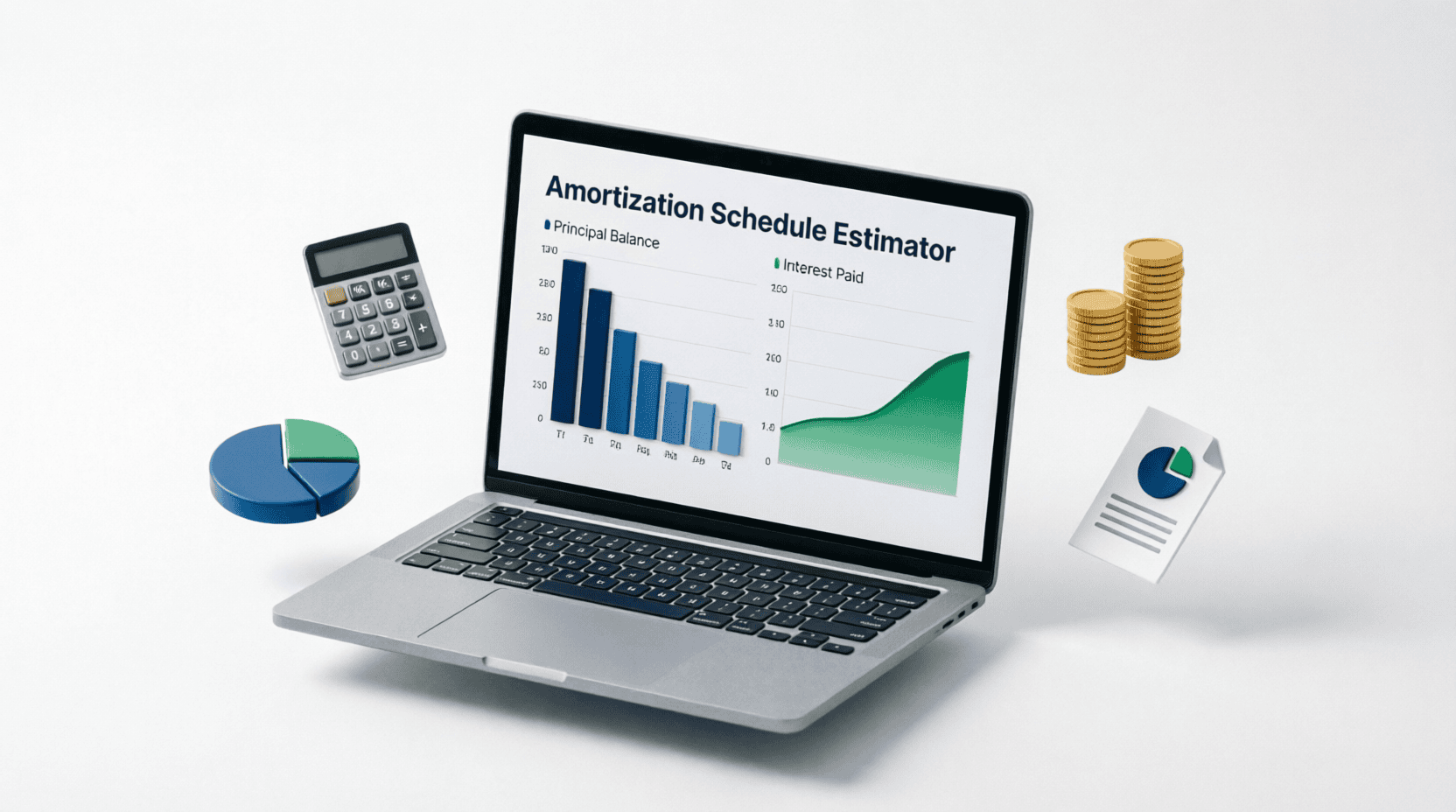
Amortization Schedule Estimator
The Amortization Schedule Calculator breaks down exactly how each payment on a fixed-rate loan splits between principal and interest, from the first payment to the last. Enter your loan amount, interest rate, and term to see your monthly payment, total interest cost, and a full payoff schedule — with an optional extra payment to see how much time and interest it could save you.
Amortization Schedule Estimator
Extra payment is optional — add it to see how much faster the loan pays off and how much interest it saves.
| Loan Amount * | Annual Interest Rate (%) * |
| Loan Term (years) * | Extra Payment per Month |
| Year | Beginning Balance | Principal Paid | Interest Paid | Ending Balance |
|---|---|---|---|---|
| Enter loan details above to generate the schedule. | ||||
Monthly Payment
Where P is the loan principal, r is the monthly interest rate (annual rate ÷ 12), and n is the total number of monthly payments.
Splitting Each Payment
Principal Portion = Payment − Interest Portion
New Balance = Remaining Balance − Principal Portion
This split is recalculated fresh for every single payment. Early on, most of the payment is interest because the balance is still high; as the balance shrinks, more of each payment goes to principal — this is why amortization schedules are “front-loaded” with interest.
Extra Payments
An extra payment is applied entirely to principal, on top of the scheduled principal portion, which reduces the balance faster and therefore reduces every subsequent interest charge. This is why even small extra payments early in a loan can meaningfully shorten the payoff time and cut total interest.
Common Uses for This Calculator
- Mortgage planning: See exactly how a home loan pays down over time
- Extra payment strategy: Test how much faster you’d pay off a loan with a fixed extra monthly amount
- Interest cost awareness: Understand how much of your early payments go to interest versus principal
- Loan comparison: Compare total interest cost across different rates or terms before committing
- Tax and accounting records: Reference annual interest paid figures for planning purposes
Worked Example: The Power of a Small Extra Payment
Take a 250,000 loan at 6.25% over a 30-year term. Without any extra payments, the base monthly payment is about 1,539, and the loan accrues roughly 303,900 in total interest over its full 360 payments — meaning you’d pay more in interest alone than the original loan amount.
With a 100/month extra payment: payoff shortens to roughly 25.5 years,
cutting total interest to approximately 250,600 — a saving of about 53,300
That’s the effect of just 100 extra per month, applied consistently: a 4.5-year shorter payoff and over 53,000 in interest avoided, simply because every extra dollar goes straight to reducing the balance that future interest is calculated on.
Frequently Asked Questions
Why is more interest paid at the start of a loan?
Interest is charged on the remaining balance each period, and that balance is at its highest right at the start of the loan, so the interest portion of each payment is largest early on and shrinks as the balance falls.
Does an extra payment reduce my required monthly payment?
No — in this calculator, the required monthly payment stays the same; the extra amount instead shortens the loan’s total length, since more principal is paid off sooner.
What’s the difference between the annual and monthly schedule views?
The annual view sums up 12 months of principal and interest into one row per year, which is easier to scan for a 15- or 30-year loan; the monthly view shows every individual payment for full detail.
Does this include property taxes and insurance?
No, this calculator covers principal and interest only. A real mortgage payment often bundles in property taxes, homeowners insurance, and sometimes PMI, which would make your actual monthly payment higher than the figure shown here.
Can I use this for something other than a mortgage?
Yes — the same amortization math applies to any fixed-rate installment loan with equal payments, including auto loans, personal loans, and some student loans.
Tips
- Confirm your exact rate and term: from your actual loan documents
- Check for prepayment penalties: before committing to extra payments on a real loan
- Remember taxes/insurance are separate: if budgeting a full mortgage payment
Understanding Loan Amortization
Amortization is the process of paying off a loan through regular, equal payments that are split differently between principal and interest at every stage of the loan. Early payments are interest-heavy because interest is calculated on the full remaining balance, while later payments are principal-heavy as that balance shrinks. An amortization schedule lays this split out payment by payment, showing exactly how the balance declines to zero by the final payment.
Understanding this front-loaded interest pattern is useful well beyond just curiosity — it explains why extra payments made early in a loan’s life save far more interest than the same extra payment made near the end, and why refinancing resets that front-loaded pattern (something worth checking with a refinance calculator before deciding to restart the clock on a new loan).
Who Uses This Calculator
Homebuyers and current homeowners reviewing their mortgage, borrowers considering extra payments to pay off debt faster, and anyone comparing loan offers with different rates or terms can use this tool to see the full payoff picture. It is for estimation and planning; always confirm your exact payment schedule and any prepayment terms with your lender.
About This Calculator
This amortization schedule estimator calculates a fixed-rate loan’s monthly payment, total interest, and full principal/interest breakdown over its term, with an optional extra payment scenario. It is intended for homeowners, borrowers, and students studying loan mechanics. Figures are estimates for planning purposes only — always confirm your exact schedule and terms with your lender before making financial decisions.