Plot Demarcation Calculator
The Plot Demarcation Calculator helps landowners, surveyors, and developers accurately calculate land area, perimeter, boundary marker (pillar/stone) requirements, and estimated fencing costs. Select the calculation you need, enter your plot dimensions, and get instant, precise results.
Calculate the total area and perimeter of a rectangular or square plot.
| Length | Width | Unit of Measurement |
Calculate the number of boundary pillars, stones, or pegs needed based on plot perimeter and desired spacing.
| Total Perimeter | Spacing Between Markers |
Estimate the total cost of fencing and boundary markers for your plot.
| Total Perimeter | Fencing Cost (per unit) | Marker Cost (each) |
| Marker Spacing | Currency/Unit: (Ensure fencing cost matches the perimeter unit, e.g., per meter or per foot) |
Understanding Plot Demarcation
Plot demarcation is the process of clearly defining the boundaries of a piece of land. This is a critical step before purchasing land, constructing a building, or installing fencing. Proper demarcation prevents boundary disputes with neighbors, ensures compliance with local zoning laws, and protects your property rights.
1. Calculating Area and Perimeter
For standard rectangular or square plots, the calculations are straightforward. The perimeter represents the total length of the boundary, while the area represents the total surface of the land.
2. Boundary Marker (Pillar) Placement
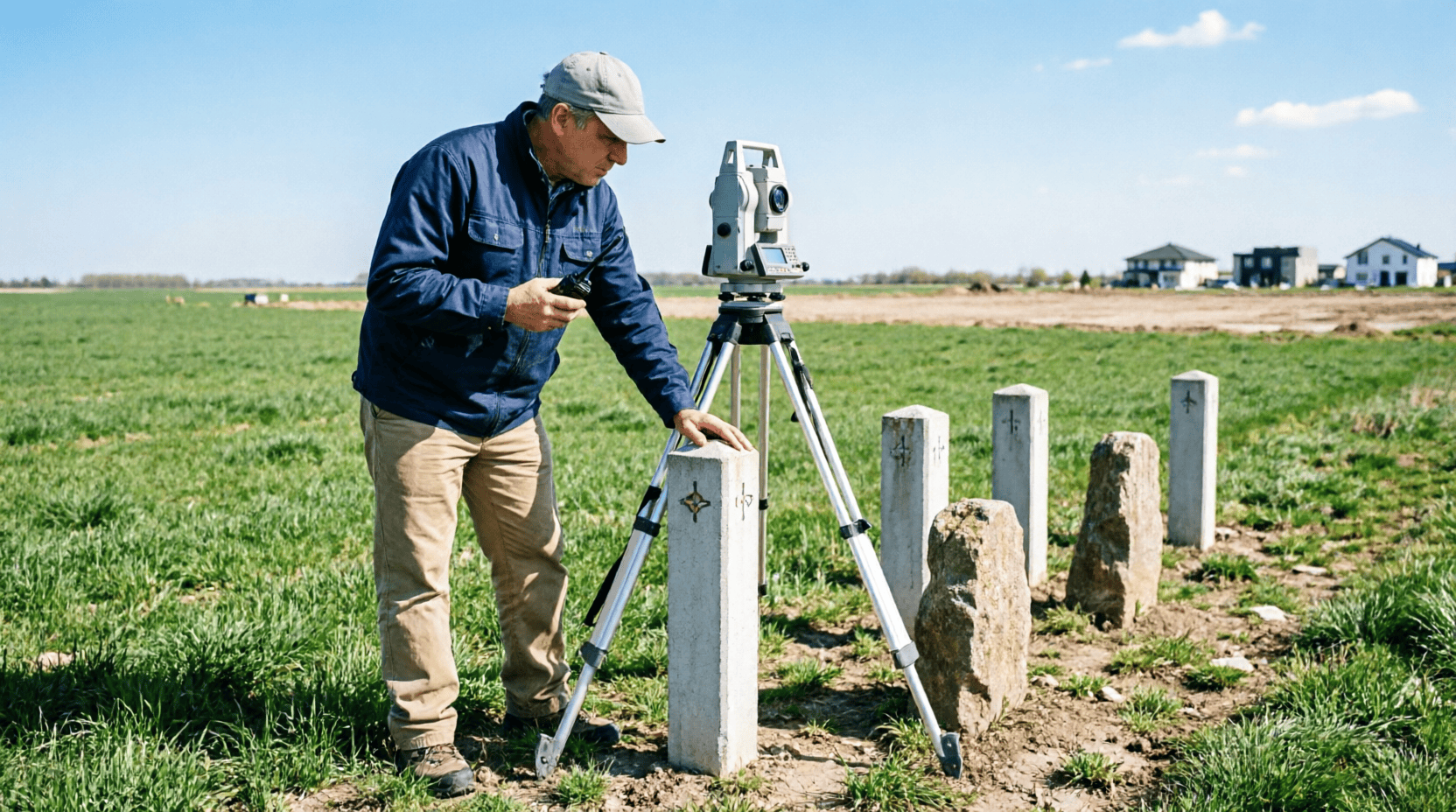
Boundary markers (concrete pillars, iron rods, or stone monuments) are placed at the corners and at regular intervals along the boundary line. For a closed loop (like a rectangular plot), the number of markers is equal to the total perimeter divided by the spacing between markers.
Total Perimeter: 160 meters
Desired Spacing: Every 5 meters
Number of Markers = 160 ÷ 5 = 32 markers.
(Note: This naturally includes the 4 corner markers, as the loop closes on itself).
3. Fencing and Cost Estimation
Once the perimeter and marker count are known, estimating costs becomes simple. Multiply the total perimeter by the cost per unit length of your chosen fencing material (e.g., chain-link, barbed wire, or masonry wall). Then, multiply the number of markers by the cost per marker.
Best Practices for Plot Demarcation
- Hire a Licensed Surveyor: Always have a professional land surveyor establish the exact legal boundaries using GPS or total station equipment before installing permanent markers.
- Check Local Regulations: Many municipalities have specific rules about how far fences or walls must be set back from the legal property line (e.g., a 1-meter setback).
- Use Durable Materials: Boundary markers should be made of durable materials like reinforced concrete or galvanized steel to withstand weather and accidental displacement.
- Document Everything: Take geotagged photographs of the markers and keep the official survey diagram (beacon certificate) in a safe place.
Frequently Asked Questions
How far apart should boundary pillars be placed?
Standard practice is to place pillars at every corner of the plot, and then at intervals of 3 to 6 meters (10 to 20 feet) along straight boundary lines. If you are installing a fence, the marker spacing often matches the fence panel length (e.g., every 2.5 or 3 meters).
What is the difference between a boundary marker and a fence?
A boundary marker (beacon/pillar) indicates the exact legal property line. A fence is a physical barrier that may be built on the boundary line or slightly inside it, depending on local setback laws. Markers should be installed before the fence.
Can I demarcate my own land?
While you can place temporary pegs to visualize the space, legal demarcation for official purposes (selling, building, or resolving disputes) must be done by a licensed land surveyor. Unauthorized boundary changes can lead to legal penalties.
How do I calculate the area of an irregular plot?
For irregular plots, the most accurate method is the “Triangulation Method.” A surveyor divides the plot into multiple triangles, measures all three sides of each triangle, and uses Heron’s Formula to calculate the area of each triangle, then adds them together.
This plot demarcation calculator is provided for estimation and planning purposes only. Always consult a licensed land surveyor and verify local municipal regulations before making permanent alterations to property boundaries.