Quadratic equation Calculator
Algebra is often misunderstood as a mere collection of abstract rules, but at its heart, it is the study of patterns, trajectories, and hidden relationships. The quadratic equation—expressed in its standard form as ax² + bx + c = 0—is perhaps the most famous of these patterns. Whether you are calculating the optimal price point for a new business venture, determining the arc of a projectile in physics, or simply navigating your advanced mathematics coursework, understanding the behavior of this equation is a fundamental skill. Enter your coefficients below to instantly solve the equation, uncover the geometry of its parabolic curve, and see the step-by-step logic that bridges the gap between raw numbers and mathematical truth.
Quadratic Equation Solver
Input the coefficients for ax² + bx + c = 0 to find the roots and analyze the curve
| Coefficient a (x² term) | Coefficient b (x term) | Coefficient c (Constant) |
The Anatomy of the Parabola
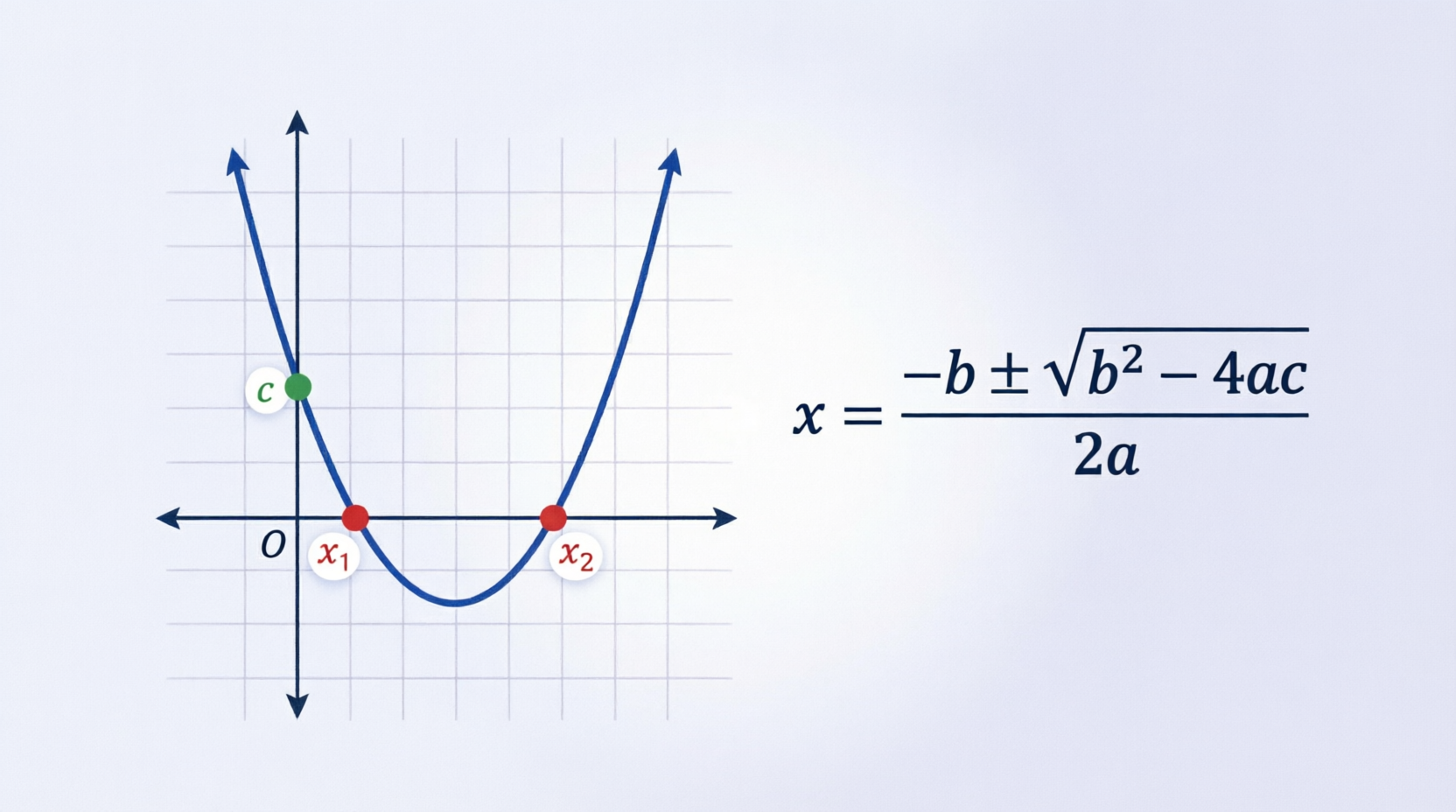
To truly master the quadratic equation, one must look beyond the mere calculation of ‘x’ and understand the shape it creates on a graph: the parabola. The three coefficients you input—a, b, and c—are not just arbitrary numbers; they are the architectural DNA of the curve. The coefficient a dictates the direction and the width of the parabola. If a is positive, the curve opens upward like a smiling mouth, representing a minimum point. If a is negative, it opens downward, representing a maximum peak. The constant c is equally straightforward—it is exactly where the curve crosses the vertical y-axis. The coefficient b, working in tandem with a, influences the horizontal placement of the curve’s peak or valley, known as the vertex. By manipulating these three values, you can model everything from the trajectory of a kicked football to the profit margins of a growing enterprise.
The Discriminant: The Gatekeeper of Reality
At the heart of the quadratic formula lies a specific expression: b² – 4ac. This is known as the discriminant (often represented by the Greek letter Delta, Δ), and it acts as a mathematical oracle, revealing the nature of the solutions before you even finish calculating them. The discriminant tells you exactly how the parabola interacts with the horizontal x-axis, which is the ultimate test of whether a “real” solution exists in the physical world.
| Discriminant Value (Δ) | Nature of the Roots | Graphical Meaning |
|---|---|---|
| Δ > 0 (Positive) | Two distinct real roots | The parabola slices through the x-axis at two separate points. |
| Δ = 0 (Zero) | One repeated real root | The vertex of the parabola just “kisses” or touches the x-axis exactly once. |
| Δ < 0 (Negative) | Two complex conjugate roots | The parabola floats entirely above or below the x-axis, never touching it. |
If the discriminant is negative, the parabola floats entirely above or below the x-axis, never touching it. In the realm of real numbers, no solution exists. Yet, mathematics does not stop at the boundaries of reality; it steps into the fascinating realm of complex and imaginary numbers, where the roots exist as conjugate pairs involving the square root of -1 (i). This tool automatically detects these conditions and provides the correct complex notation.
Real-World Applications of Quadratics
While it is easy to view quadratics as an abstract classroom exercise, they are the hidden engine behind countless real-world phenomena. Understanding how to solve them allows professionals across various industries to optimize outcomes and predict physical behaviors.
- Physics and Projectile Motion: Whenever an object is thrown, launched, or dropped near the surface of the Earth, gravity pulls it down in a parabolic arc. The height of the object over time is modeled by a quadratic equation. By finding the roots, engineers can calculate exactly when a projectile will hit the ground; by finding the vertex, they can determine its maximum altitude.
- Business and Profit Maximization: In economics, profit is often a quadratic function. Revenue might increase as you lower prices to sell more units, but costs rise with production volume. The resulting profit curve is a parabola. The vertex of this curve reveals the exact number of units a business must produce to achieve maximum possible profit, while the roots represent the “break-even” points where profit is zero.
- Automotive Safety: The braking distance of a car is not linear; it increases quadratically with speed. If you double your speed, your braking distance quadruples. Traffic engineers use quadratic models to design safe speed limits and calculate the necessary lengths of deceleration lanes on highways.
Step-by-Step Walkthrough
To illustrate the power of the quadratic formula, let us manually solve an equation that frequently appears in algebraic coursework: 2x² – 4x – 6 = 0.
a = 2, b = -4, c = -6
Step 1: Calculate the Discriminant (Δ)
Δ = b² – 4ac
Δ = (-4)² – 4(2)(-6)
Δ = 16 – (-48) = 64
Because 64 is greater than zero, we know immediately that there are two distinct real roots.
Step 2: Apply the Quadratic Formula
x = (-b ± √Δ) / 2a
x = (-(-4) ± √64) / 2(2)
x = (4 ± 8) / 4
Step 3: Solve for Both Roots
x₁ = (4 + 8) / 4 = 12 / 4 = 3
x₂ = (4 – 8) / 4 = -4 / 4 = -1
Conclusion: The equation has two real solutions: x = 3 and x = -1. If you graph y = 2x² – 4x – 6, the curve will cross the x-axis exactly at these two points.
Beyond the Formula: The Power of Vertex Form
While the quadratic formula is the most reliable tool for finding roots, another profound way to view this equation is through “completing the square,” which transforms the standard form into the vertex form: a(x – h)² + k = 0. In this format, the coordinates of the vertex (h, k) are laid bare. The x-coordinate of the vertex (h) is always found by calculating -b / 2a. This specific value is deeply significant—it represents the exact axis of symmetry for the parabola, and it is also the precise midpoint between the two real roots (if they exist). By calculating the vertex, this tool provides you with the ultimate high or low point of the curve, which is incredibly useful in optimization problems.
0 for the coefficient a, the x² term vanishes. The equation degrades from a quadratic curve into a simple linear line (bx + c = 0). The calculator will automatically detect this edge case and solve for the single intersection point of that line, or alert you if the equation becomes a mathematical impossibility (e.g., 0x + 5 = 0).
Frequently Asked Questions
Can a quadratic equation have no solution?
In the realm of real numbers, yes. If the discriminant is negative (Δ < 0), the parabola never touches the x-axis, meaning there are no real x-intercepts. However, in advanced mathematics, we use imaginary numbers (denoted by i, where i² = -1) to express these solutions as complex conjugates. This calculator will display those complex roots if they exist.
Why use the quadratic formula instead of just factoring?
Factoring is a fantastic mental exercise and is often faster for simple equations with integer roots (like x² – 5x + 6 = 0). However, the vast majority of quadratic equations in the real world do not factor neatly into whole numbers. The quadratic formula is a universal key; it will always work, regardless of how messy the coefficients are or whether the roots are irrational decimals or complex numbers.
What happens if ‘a’ is zero?
If the coefficient ‘a’ is zero, the x² term disappears, and the equation is no longer quadratic—it becomes a linear equation (bx + c = 0). Graphically, this means the curve flattens out into a straight diagonal line. This calculator is programmed to recognize this scenario and will seamlessly switch to solving a linear equation, providing the single root where the line crosses the x-axis.
How do I know if the parabola opens up or down?
Look exclusively at the sign of the coefficient a. If a is positive (greater than zero), the parabola opens upward, forming a “U” shape, and the vertex represents the absolute minimum value of the function. If a is negative (less than zero), the parabola opens downward, forming an inverted “U” shape, and the vertex represents the absolute maximum value.
This quadratic equation calculator is provided for educational, analytical, and problem-solving purposes. It accurately handles real, repeated, and complex imaginary roots, as well as linear edge cases. Always verify your manual algebraic steps against these computational results to ensure absolute accuracy in your examinations or professional work.