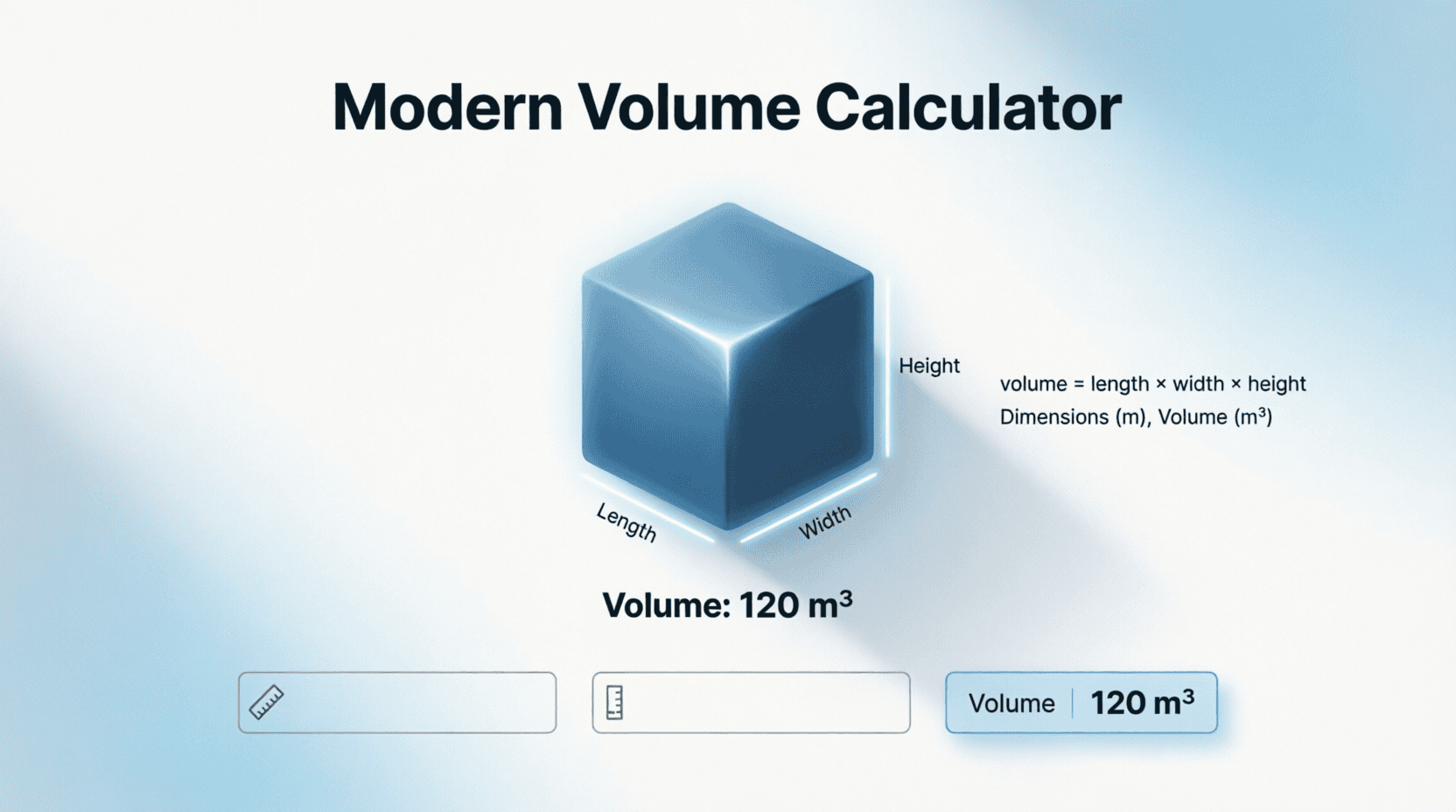
Volume Calculator
Calculate the volume of any 3D shape — cube, cylinder, sphere, or cone — and convert between liters, cubic meters, and gallons. Perfect for water tanks, grain silos, concrete foundations, and fuel storage in Zambia.
Volume Calculator
Select a shape and enter its dimensions to calculate the volume.
Convert between common volume units used in Zambia.
- 1 Cubic Meter (m³) = 1,000 Liters
- 1 Liter = 1,000 Milliliters (ml)
- 1 US Gallon = 3.785 Liters
- 1 Imperial Gallon = 4.546 Liters
- 1 Cubic Foot = 28.317 Liters
Common Water Tanks in Zambia
| Tank Type | Dimensions (Typical) | Capacity (Liters) | Capacity (m³) | Common Use |
|---|---|---|---|---|
| 200L Drum | 60cm diameter × 90cm height | 200 L | 0.2 m³ | Small household, farming chemicals |
| IBC Tank (1000L) | 1m × 1m × 1.2m | 1,000 L | 1.0 m³ | Medium household, irrigation |
| Jojo Tank 2,500L | 1.5m diameter × 1.6m height | 2,500 L | 2.5 m³ | Large household, small farm |
| Jojo Tank 5,000L | 1.9m diameter × 1.9m height | 5,000 L | 5.0 m³ | Commercial, irrigation |
| Jojo Tank 10,000L | 2.4m diameter × 2.4m height | 10,000 L | 10.0 m³ | Large farm, commercial |
| Rectangular Tank 5,000L | 2m × 1.5m × 1.7m | 5,000 L | 5.0 m³ | Custom built, underground |
Rainwater Harvesting Potential
In Zambia, average annual rainfall varies by region:
- Lusaka: 800–900 mm per year
- Copperbelt: 1,200–1,400 mm per year
- Eastern Province: 800–1,000 mm per year
- North-Western: 1,200–1,500 mm per year
Volume (Liters) = Roof Area (m²) × Rainfall (mm) × 0.8 (efficiency factor)
Example: A 100 m² roof in Lusaka (850mm rainfall):
100 × 850 × 0.8 = 68,000 liters per year (68 m³)
Grain Storage (Maize)
| Storage Type | Capacity | Maize (50kg bags) | Notes |
|---|---|---|---|
| Traditional Cribs | 500–2,000 kg | 10–40 bags | Rural, natural ventilation |
| Metal Silos | 500–5,000 kg | 10–100 bags | Airtight, pest-proof |
| Warehouse (small) | 10–50 tonnes | 200–1,000 bags | Commercial storage |
| Grain Silo (large) | 100+ tonnes | 2,000+ bags | Large-scale commercial |
Concrete for Construction
For building foundations, floors, and columns in Zambia, typical concrete volumes are:
- Foundation trench (per meter): 0.3m × 0.6m × 1m = 0.18 m³ (180 liters)
- Floor screed (50mm thick, per m²): 0.05 m³ (50 liters)
- Standard column (3m height, 300mm × 300mm): 0.27 m³ (270 liters)
How many liters are in a cubic meter?
1 cubic meter (m³) = 1,000 liters. This is a standard metric conversion used worldwide, including in Zambia.
How do I calculate the volume of a cylindrical water tank?
Use the cylinder formula: Volume = π × r² × h (where r = radius, h = height). For example, a Jojo tank with 1.5m diameter (0.75m radius) and 1.6m height:
Volume = π × 0.75² × 1.6 = 2.83 m³ = 2,830 liters
How much water can I collect from my roof?
Use the formula: Roof Area (m²) × Annual Rainfall (mm) × 0.8 (efficiency). A 100 m² roof in Lusaka (850mm rainfall) can collect approximately 68,000 liters per year.
How many bags of cement do I need for 1 cubic meter of concrete?
For a standard 1:2:4 mix, you need approximately 7 bags of cement (50kg each) per cubic meter of concrete. This includes sand and gravel.
What is the difference between liters and gallons?
A liter is a metric unit. A US gallon = 3.785 liters. An Imperial (UK) gallon = 4.546 liters. In Zambia, liters are the standard unit for most applications.
How do I calculate the volume of an irregularly shaped tank?
For irregular tanks, divide the shape into simpler geometric shapes (cubes, cylinders) and calculate each separately. Add them together for the total volume. Alternatively, fill the tank with a known volume of water and measure directly.
How much does 1,000 liters of water weigh?
1,000 liters of water weighs exactly 1,000 kg (1 tonne). This is important for structural calculations when placing large tanks on roofs or elevated platforms.
Can I use this calculator for fuel tanks?
Yes! The volume calculator works for any liquid. Just remember that diesel and petrol are slightly less dense than water (about 0.85 kg per liter), so 1,000 liters of diesel weighs approximately 850 kg.
Understanding Volume Calculations
Volume measures the amount of three-dimensional space an object occupies. It is expressed in cubic units (m³, ft³) or liquid units (liters, gallons). Knowing how to calculate volume is essential for:
- Water storage: Sizing tanks for households, irrigation, and rainwater harvesting
- Construction: Calculating concrete for foundations, columns, and floors
- Agriculture: Grain silo capacity, chemical mixing, and irrigation planning
- Fuel storage: Diesel tanks for generators and farm equipment
- Swimming pools: Water volume and chemical treatment
Common Volume Formulas
Cylinder: Volume = π × r² × h (r = radius, h = height)
Sphere: Volume = (4/3) × π × r³
Cone: Volume = (1/3) × π × r² × h
Triangular Prism: Volume = ½ × Base × Height × Length
Key Volume Conversions
- 1 m³ = 1,000 liters (most important conversion in Zambia)
- 1 liter = 1,000 milliliters (ml)
- 1 US gallon = 3.785 liters
- 1 Imperial gallon = 4.546 liters
- 1 cubic foot = 28.317 liters
- 1 cubic yard = 764.555 liters
Disclaimer: This calculator provides mathematical volume calculations based on the dimensions you enter. For engineering, construction, or commercial applications, always consult with qualified professionals and verify calculations against manufacturer specifications.