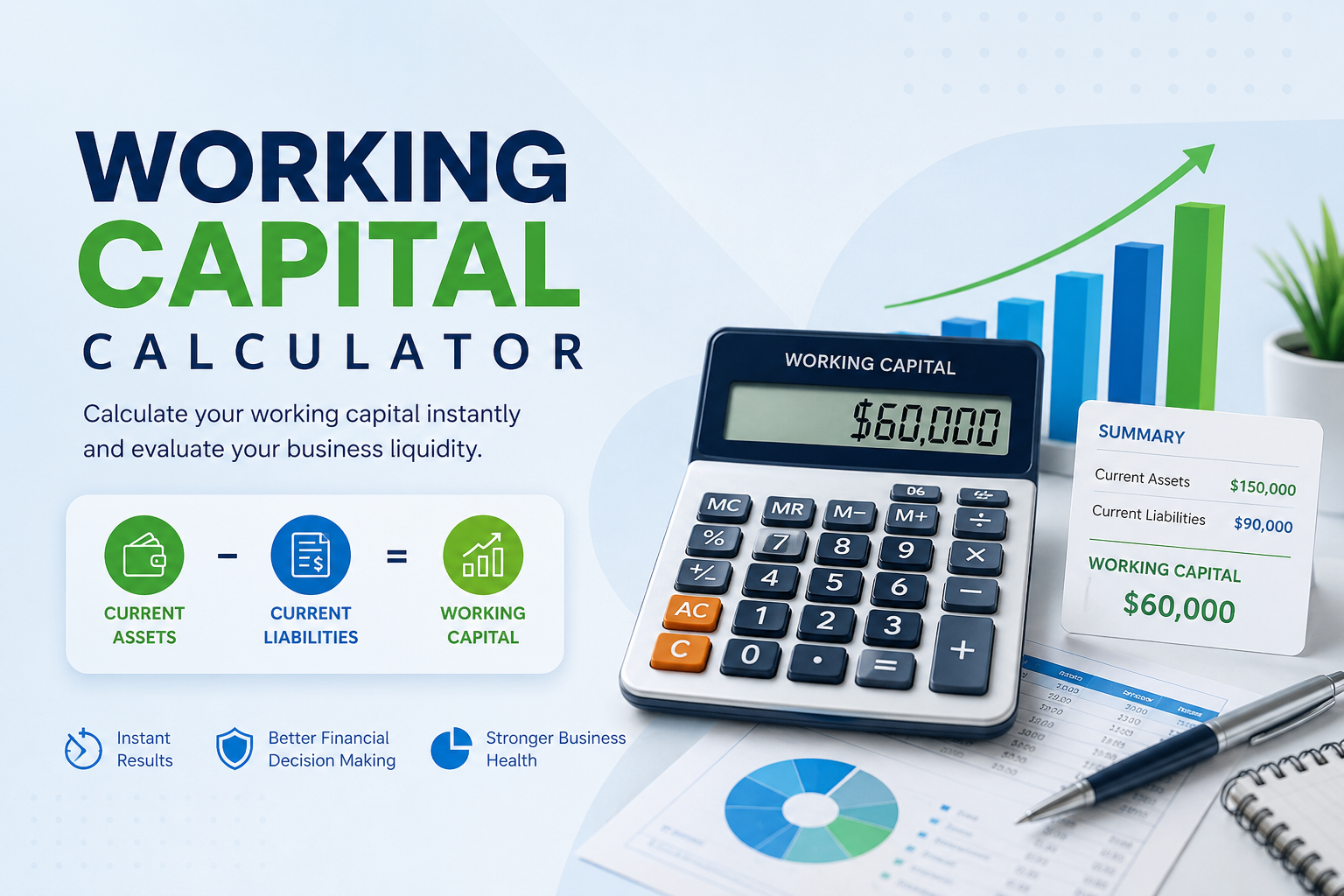
Working Capital Calculator
Calculate your business’s working capital and current ratio instantly. This free calculator helps Zambian students (ECZ Business Studies, UNZA, CBU) and entrepreneurs measure short-term financial health, analyze liquidity, and plan for sustainable growth.
Working Capital Calculator
Enter your current assets and current liabilities to calculate working capital, current ratio, and financial health assessment.
|
Current Assets (ZMW)
Cash, inventory, accounts receivable, short-term investments
|
Current Liabilities (ZMW)
Accounts payable, short-term loans, accrued expenses, taxes payable
|
| Currency | |
The current ratio is a liquidity metric showing your ability to pay short-term obligations.
Understanding Current Ratio Values:
| Current Ratio | Interpretation | Zambian Business Context |
|---|---|---|
| > 2.0 | Excellent liquidity | Strong position for expansion or investment |
| 1.5 – 2.0 | Good liquidity | Healthy for most SMEs in Zambia |
| 1.0 – 1.5 | Adequate liquidity | Monitor cash flow closely |
| < 1.0 | Poor liquidity | Risk of cash flow problems; seek financing |
Example 1: Lusaka Retail Shop
• Cash in bank: ZMW 15,000
• Inventory (clothing stock): ZMW 45,000
• Accounts receivable: ZMW 10,000
• Accounts payable: ZMW 25,000
• Short-term loan: ZMW 20,000
Step 2: Current Liabilities = 25,000 + 20,000 = ZMW 45,000
Step 3: Working Capital = 70,000 – 45,000 = ZMW 25,000
Step 4: Current Ratio = 70,000 ÷ 45,000 = 1.56
Example 2: Ndola Manufacturing Company
Current Ratio = 500,000 ÷ 600,000 = 0.83
- Improve receivables collection
- Reduce inventory levels
- Negotiate longer payment terms with suppliers
- Consider short-term financing options
What is a good working capital amount?
There’s no universal “good” amount — it depends on your business size and industry. What matters is that working capital is positive and sufficient to cover short-term obligations. A current ratio of 1.5–2.0 is generally healthy for Zambian SMEs.
Can working capital be negative?
Yes, but it’s a warning sign. Negative working capital means current liabilities exceed current assets, which can lead to cash flow problems. Some businesses (like supermarkets) can operate with negative working capital due to fast inventory turnover, but this requires careful management.
Does this work for ECZ Business Studies exams?
Absolutely! This calculator follows the ECZ Business Studies syllabus. Use it to practice working capital calculations, understand the current ratio, and prepare for Paper 2 financial management questions.
What is included in Current Assets?
Current assets typically include:
- Cash and bank balances
- Accounts receivable (money owed by customers)
- Inventory (stock of goods)
- Short-term investments
- Prepaid expenses
What is included in Current Liabilities?
Current liabilities typically include:
- Accounts payable (money owed to suppliers)
- Short-term loans and overdrafts
- Accrued expenses (wages, utilities)
- Taxes payable
- Current portion of long-term debt
Why is working capital important in Zambia?
Many Zambian SMEs face cash flow challenges due to delayed payments from government contracts or large corporations. Building a working capital buffer of at least 2–3 months of operating expenses protects your business during lean periods.
How can I improve my working capital?
Key strategies include:
- Manage inventory wisely — avoid overstocking slow-moving items
- Speed up receivables — offer early payment discounts, follow up on overdue invoices
- Negotiate payables — request longer payment terms from suppliers
- Monitor regularly — calculate working capital monthly and track trends
About Working Capital
Working capital is the difference between a business’s current assets and current liabilities. It measures a company’s short-term financial health and operational efficiency. Working capital is a core topic in Zambia’s ECZ Business Studies and UNZA/CBU accounting programs.
Why Working Capital Matters in Zambia
Working capital analysis is essential for:
- ECZ Business Studies – Grade 12 Paper 2 financial management
- UNZA/CBU Accounting – Financial accounting and management courses
- Entrepreneurship Programs – Business planning and startup finance
- Banking & Finance – Credit assessment and loan applications
- Business Management – Operational efficiency and cash flow planning
Practical Applications for Zambian Businesses:
- Retail & Trade: Manage inventory purchases, supplier payments, and seasonal cash flow in markets like Soweto or City Market
- Agriculture: Plan for seasonal inputs (seeds, fertilizer) and manage cash flow between harvest cycles
- Construction: Handle project-based cash flow, material purchases, and contractor payments
- Professional Services: Manage receivables from clients and ensure sufficient cash for operational expenses
This working capital calculator is provided for informational and educational purposes only. It is designed to help students, entrepreneurs, and business owners understand basic financial concepts. For professional financial advice, loan applications, or audit purposes, always consult a qualified accountant or financial advisor registered with professional bodies in Zambia.