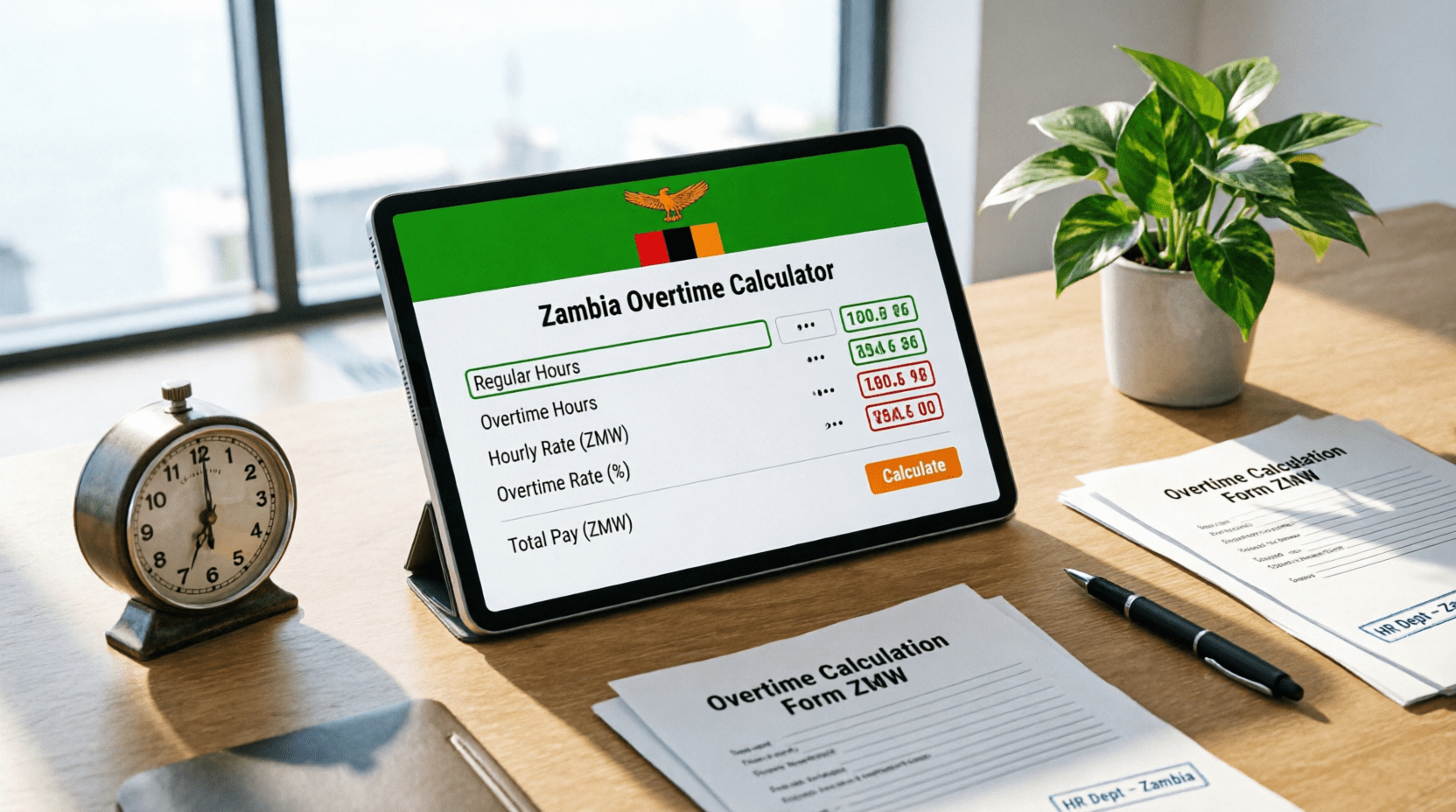
Zambia Overtime Calculator
The Zambia Overtime Calculator helps employees and employers quickly calculate overtime pay based on Zambian employment law. Whether you earn a daily, weekly, or monthly wage, this tool converts your regular rate to an hourly rate and applies the correct overtime multipliers (1.5× for standard overtime and 2× for weekend or public holiday work). Use it to verify your pay slips, negotiate employment contracts, or plan payroll calculations. Always verify current labor law requirements with the Ministry of Labour and Social Security.
Overtime Calculator
Enter your hourly rate to calculate overtime pay for standard overtime and weekend/holiday work.
| Hourly Rate (ZMW) | Hours Worked | Day Type |
Enter your daily rate. The calculator assumes an 8-hour standard workday and converts to hourly for overtime calculations.
| Daily Rate (ZMW) | Hours Worked (Overtime) | Overtime Type |
Enter your monthly salary to calculate overtime on a per-hour basis. Uses 160 standard hours per month (20 working days × 8 hours).
| Monthly Salary (ZMW) | Overtime Hours | Overtime Type |
About Overtime in Zambia
Overtime in Zambia is regulated under the Employment Act and related labor legislation administered by the Ministry of Labour and Social Security. Overtime occurs when an employee works beyond the standard hours of work agreed in their employment contract, typically more than 8 hours in a day or 40 hours in a week. Employers are required by law to pay additional compensation for overtime work, with rates varying depending on when the work is performed — whether on normal days, weekends, or public holidays. Understanding overtime rights and obligations is essential for both employees seeking fair compensation and employers managing labor costs accurately.
Overtime Rates in Zambia
Zambian employment law prescribes specific multipliers for overtime payment. The standard overtime rate is 1.5 times the regular hourly rate (also called time-and-a-half) and applies to work performed beyond standard hours on normal working days. Work performed on Saturdays, Sundays, and public holidays is compensated at 2 times the regular hourly rate (double time). These multipliers ensure that workers receive fair compensation when required to work outside their standard schedule. These rates are set by the Employment Act and apply to all employees in Zambia unless a written employment contract specifies a higher rate.
Overtime Calculation Formulas
Calculating overtime correctly requires converting your wage (whether daily or monthly) into an hourly rate, then multiplying by the appropriate overtime factor.
Overtime Pay = Hourly Rate × Multiplier × Hours
── From Daily Rate ───────────────────────────
Hourly Rate = Daily Rate ÷ 8 hours
Overtime Pay = Hourly Rate × Multiplier × Hours
── From Monthly Salary ────────────────────────
Hourly Rate = Monthly Salary ÷ 160 hours*
Overtime Pay = Hourly Rate × Multiplier × Hours
* Assumes 20 working days/month, 8 hours/day = 160 hours
Worked Examples
Hourly Rate: K60
Works 5 hours of standard overtime on a Tuesday
Overtime Pay = K60 × 1.5 × 5 = K450.00
Example 2 — Daily Wage Worker:
Daily Rate: K500 (for 8-hour day)
Works 4 hours of overtime on Saturday
Hourly Rate = K500 ÷ 8 = K62.50
Overtime Pay = K62.50 × 2 × 4 = K500.00
Example 3 — Salaried Employee:
Monthly Salary: K10,000
Works 12 hours of overtime in the month (standard overtime)
Hourly Rate = K10,000 ÷ 160 = K62.50
Overtime Pay = K62.50 × 1.5 × 12 = K1,125.00
Employment Act and Overtime Provisions
The Employment Act of Zambia establishes the legal framework for employment relationships, including rights and obligations regarding working hours and overtime. The Act sets a maximum of 40 standard working hours per week and provides that any work performed beyond these hours must be compensated at the prescribed overtime rates. The Act also protects employees from excessive working hours and requires that overtime be reasonable and not used as a substitute for adequate staffing. Employers who breach overtime payment obligations are subject to penalties and may be required to compensate employees for unpaid overtime, including potential interest and legal costs.
Standard Working Hours in Zambia
The Employment Act prescribes that the standard working week in Zambia shall not exceed 40 hours, typically spread over five days (Monday to Friday), with each day consisting of 8 standard hours. A standard working day also includes paid breaks, which do not count as working time but are part of the employee’s time at the workplace. The actual hours may vary by agreement between employer and employee, but 40 hours per week is the baseline. Any hours worked beyond 40 hours in a week, or beyond 8 hours in a day, are generally classified as overtime unless the contract specifies otherwise.
Overtime Payment Methods
Overtime compensation in Zambia is typically paid in cash at the end of the pay period (weekly, fortnightly, or monthly) alongside regular wages. Some employers offer alternatives such as time-off-in-lieu (TOIL), where employees take additional paid leave equal to their overtime hours multiplied by the overtime factor. For example, 5 hours of standard overtime (1.5×) may be converted to 7.5 hours of additional leave. However, time-off-in-lieu must be mutually agreed and cannot reduce the employee’s total compensation below what would have been paid in cash.
Overtime and NAPSA Contributions
Overtime pay is generally subject to NAPSA (National Pension Scheme Authority) contributions in Zambia, meaning overtime income is pensionable and contributes to an employee’s retirement benefits. Employers must withhold employee NAPSA contributions (currently 5% of gross income, including overtime) and remit employer contributions (also 5%) to NAPSA monthly. This means overtime income increases both the employee’s pension contributions and the employer’s labor costs. Employees should verify their pay slips to ensure NAPSA contributions are correctly calculated on overtime amounts.
Overtime and Income Tax (PAYE)
Overtime income is subject to PAYE (Pay As You Earn) tax in Zambia. The overtime amount is added to the employee’s regular wages, and PAYE is calculated on the total income using the progressive tax brackets set by the Zambia Revenue Authority (ZRA). This means that high overtime can push an employee into a higher tax bracket, increasing their marginal tax rate. All income, including overtime, must be declared and taxed. Employees should check their pay slips to confirm that PAYE has been correctly calculated on overtime earnings.
Disputed Overtime and Legal Remedies
If an employee believes they have worked overtime but not been paid the correct amount (or not paid at all), they have the right to lodge a complaint with the Ministry of Labour and Social Security or seek redress through the Industrial Relations Court. The burden of proof typically rests with the employer to demonstrate that overtime was not worked or that payment was made correctly. Employees should keep detailed records of all hours worked, including dates, times, and the nature of work, to support any overtime claim. Many labor disputes in Zambia concern unpaid or underpaid overtime, and the courts consistently award compensation to employees who can evidence their overtime work.
Best Practices for Overtime Management
- Record All Hours: Keep a detailed log of all hours worked, including overtime. Both employers and employees benefit from accurate time records.
- Agree in Writing: If overtime is expected, include clauses in the employment contract specifying how overtime will be managed, approved, and paid.
- Pay Promptly: Overtime should be paid in full with the next regular pay period. Delayed overtime payment is a compliance violation.
- Calculate Correctly: Use the statutory rates (1.5× and 2×) unless the contract specifies a higher rate. Do not use lower rates or attempt to negotiate down from statutory minimums.
- Document Payment: Ensure pay slips clearly show overtime hours, the multiplier applied, the overtime amount, and any deductions (NAPSA, PAYE). This provides evidence of compliance.
- Monitor Workload: Regular excessive overtime may indicate understaffing. Employers should balance workload to limit the need for constant overtime.
Frequently Asked Questions
What is the legal overtime rate in Zambia?
The standard overtime rate is 1.5 times (time-and-a-half) the regular hourly rate. Work on Saturdays, Sundays, and public holidays is paid at 2 times (double time) the regular hourly rate. Employment contracts may specify higher rates, but not lower.
How many hours per week can an employer require an employee to work?
The standard working week in Zambia is 40 hours. Hours beyond 40 per week (or 8 per day) are overtime and must be compensated at the prescribed rates. Employers cannot require unreasonable overtime without compensation.
Is overtime work voluntary in Zambia?
Overtime is generally at the employer’s request, not the employee’s choice. However, employees cannot be forced to work unsafe or unreasonable amounts of overtime. If overtime is a normal part of a role, it should be stated in the employment contract. Refusal to perform reasonable requested overtime may be grounds for discipline, but the employer must still pay for any overtime actually worked.
Do I have to accept time-off-in-lieu instead of cash for overtime?
No. You have the right to cash payment for overtime at the statutory rates. Time-off-in-lieu can only be used if you and your employer mutually agree, and it must not reduce your total compensation below the cash equivalent.
Is overtime subject to NAPSA and income tax?
Yes. Overtime is treated as part of your gross income, subject to both NAPSA contributions (5% employee, 5% employer) and PAYE income tax. The overtime is added to your regular income and taxed at the appropriate progressive rate.
What if my employer refuses to pay overtime?
You have the right to file a complaint with the Ministry of Labour and Social Security or petition the Industrial Relations Court for unpaid wages. Keep records of all hours worked and present evidence (time sheets, emails, witness statements) to support your claim.
Can an employment contract override the statutory overtime rates?
Employment contracts can offer overtime rates higher than the statutory rates (1.5× and 2×), but they cannot offer lower rates. Any contract clause setting overtime below statutory rates is unenforceable and void under the Employment Act.
Additional Resources
For comprehensive employment information and support, consult these trusted Zambian resources:
- Ministry of Labour and Social Security — Employment policies, acts, and regulations
- Judiciary of Zambia — Industrial Relations Court — Labor dispute resolution
- NAPSA (National Pension Scheme Authority) — Retirement benefits and contributions
- ZRA (Zambia Revenue Authority) — PAYE tax rates and obligations
- ZICA (Zambia Institute of Chartered Accountants) — Professional accounting and payroll services
This overtime calculator is provided for informational and planning purposes only. Overtime rates and regulations are set by the Zambian Employment Act and may be amended through legislation. This tool does not constitute legal or employment advice. Always verify the current overtime rates and your employment rights with the Ministry of Labour and Social Security or a qualified employment law professional before making decisions based on overtime calculations.