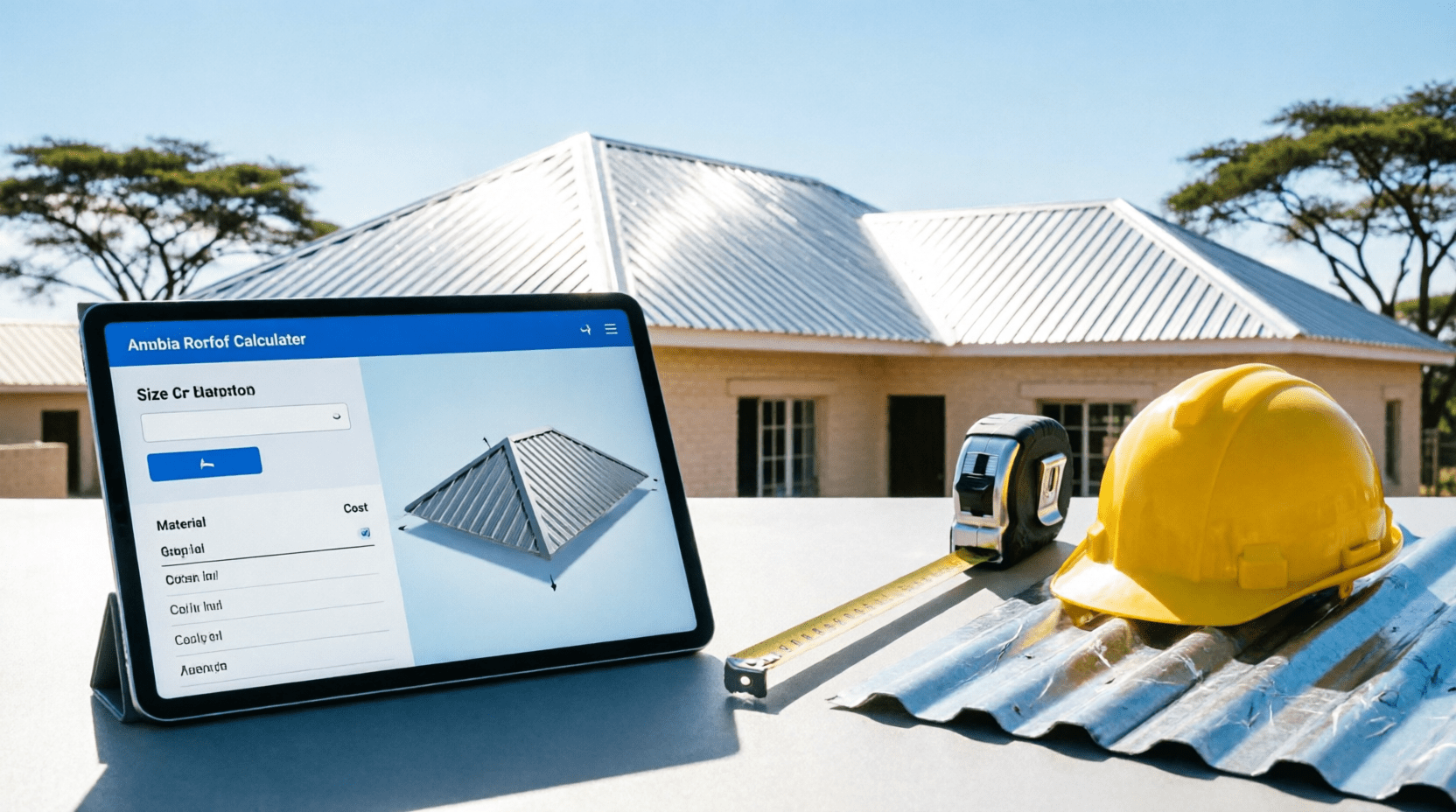
Zambia roofing calculator
How Many Roofing Sheets
Do I Need? Calculate in Seconds.
Whether you’re building in Lusaka, Kitwe, Ndola or a rural village — stop guessing and stop wasting money on extra sheets. Enter your measurements below and get a precise count for corrugated iron, IBR or box profile sheets, including Zambian wastage rates and ZMW price estimates.
and tap Calculate My Sheets
Roofing Sheets in Zambia: A Complete Buyer’s Guide (2024)
Roofing is one of the single biggest expenses in any Zambian construction project — whether you are building a modest two-bedroom home in Kafue, a large warehouse in Lusaka South Multi-Facility Economic Zone, or a church hall in the Eastern Province. Getting the sheet count wrong by even 10% can mean either costly extra trips to the hardware store or hundreds of sheets going to waste. This guide explains exactly how to calculate roofing sheets for Zambian conditions, what sheet types are available locally, current 2024 prices in Zambian Kwacha, and how professional builders approach the job.
To calculate roofing sheets needed: (Roof Length ÷ Sheet Effective Width) × (Slope Run × Pitch Factor ÷ Effective Sheet Length) × Number of Slopes × (1 + Wastage %). Use our calculator above — it does all this in one click.
Sheet Types Available in Zambia
Four types of roofing sheet dominate the Zambian market. Each has different dimensions, coverage, and costs. Knowing the difference is critical before you buy.
2024 Roofing Sheet Prices in Zambia (ZMW)
Prices below are typical retail rates at hardware stores in Lusaka, Kitwe and Ndola as of mid-2024. Prices vary by gauge, supplier, and whether you are buying in bulk. Always ask for a bulk discount when ordering more than 50 sheets.
| Sheet Type | Size | Gauge | Price per Sheet ZMW | Coverage per Sheet |
|---|---|---|---|---|
| Corrugated Iron 2.4m | 762 × 2400mm | 0.47mm BMT | K55 – K75 | ~0.686 × 2.4m |
| Corrugated Iron 3.0m | 762 × 3000mm | 0.47mm BMT | K70 – K95 | ~0.686 × 3.0m |
| IBR Sheet 2.0m | 686 × 2000mm | 0.47mm BMT | K50 – K65 | ~0.608 × 2.0m |
| IBR Sheet 3.0m | 686 × 3000mm | 0.47mm BMT | K80 – K110 | ~0.608 × 3.0m |
| Box Profile 3.0m | 1000 × 3000mm | 0.50mm BMT | K100 – K130 | ~0.950 × 3.0m |
| Flat Sheet 2.0m | 1100 × 2000mm | 0.40mm BMT | K40 – K55 | ~1.000 × 2.0m |
⚠️ Beware of Sub-Standard Sheets: Zambia has seen an influx of imported sheets below 0.40mm BMT sold at attractive prices. These sheets rust within 2–3 rainy seasons. Always ask your supplier for the gauge certificate and buy from reputable dealers like Steelco Zambia, Metal Fabricators of Zambia (ZAMEFA), or Roan Roofing Products.
How to Calculate Roofing Sheets — Step by Step
The calculator above handles this automatically, but understanding the formula helps you verify the result and explain it to your foreman or hardware supplier.
-
Measure your building footprint Measure the external length and width of the building in metres. For a typical Lusaka 3-bedroom home this might be 12m × 8m. Do not measure the roof slope — just the flat ground footprint.
-
Determine the roof pitch Pitch is the angle of the roof in degrees. Most Zambian homes use 20°–30°. A steeper pitch sheds rain faster (important for the Copperbelt’s heavy rainfall) but requires more sheets. To measure: for every 1m horizontal run, measure the vertical rise. Pitch = arctan(rise ÷ run).
-
Calculate the pitch factor Pitch Factor = 1 ÷ cos(pitch in degrees). For 20° this is 1 ÷ cos(20°) = 1.064. This converts your flat plan area into the actual sloped roof area.
-
Calculate actual roof area Actual Area (m²) = Length × Width × Pitch Factor. Example: 12 × 8 × 1.064 = 102.1 m² for a gable roof.
-
Divide by effective sheet coverage Each corrugated sheet covers 0.686m wide × (sheet length − end lap) long. For a 2.4m sheet with 150mm lap: 0.686 × 2.25 = 1.54 m² per sheet. Divide your actual area by this: 102.1 ÷ 1.54 = 67 sheets net.
-
Add wastage allowance Add 10–15% for offcuts, damage in transit, and future repairs. 67 × 1.12 = 75 sheets to order.
Corrugated vs IBR vs Box Profile — Which is Best for Zambia?
Each sheet type suits different budgets, building types and locations in Zambia. Here is how they compare:
| Feature | Corrugated | IBR | Box Profile |
|---|---|---|---|
| Price (per m²) | K35–50 | K40–60 | K50–75 |
| Wind resistance | Moderate | Good | Excellent |
| Rainfall shedding | Very good | Very good | Good |
| Min. recommended pitch | 5° | 3° | 2° |
| Availability in Zambia | Everywhere | Major towns | Lusaka/Copperbelt mainly |
| Lifespan (good gauge) | 15–25 yrs | 20–30 yrs | 25–35 yrs |
| DIY install difficulty | Easy | Moderate | Moderate |
| Best suited for | Homes, rural | Offices, homes | Commercial, large span |
Regional Roofing Tips Across Zambia
🏙️ Lusaka & Surrounding Districts
Lusaka receives around 800–900mm of rainfall annually, mostly between November and April. The ridge areas (Kabulonga, Roma, Ibex Hill) experience stronger winds due to elevated terrain. For these areas, use IBR or Box Profile sheets with a minimum 25° pitch. Fix with J-bolts at 600mm purlin spacings and always use rubber-backed roofing screws, not nails.
⛏️ Copperbelt Province (Kitwe, Ndola, Mufulira)
The Copperbelt is Zambia’s rainiest region, with some areas receiving over 1,200mm per year. Industrial pollution in mining towns also accelerates corrosion. Specify minimum 0.47mm BMT galvanised sheets, or better, Zincalume-coated sheets for buildings within 2km of mine operations. IBR at 30°+ pitch with 150mm end laps is the professional standard here.
🌳 Eastern & Northern Provinces
Rural areas in Eastern and Northern Province have historically used corrugated sheets transported from Lusaka or Chipata. Delivery costs can be significant — it often makes sense to over-order by 15–20% to avoid expensive return trips for a handful of sheets. Factor transport cost into your total budget estimate.
☀️ Southern Province (Livingstone, Choma)
Lower rainfall than the rest of Zambia (under 700mm in many areas), but higher UV exposure. Southern Province roofs degrade faster due to UV and thermal cycling — sheets expand and contract daily. Use thicker gauge (0.53mm) and consider colour-coated Zincalume to reduce heat absorption and extend lifespan.
Purlin Spacing Guide for Zambia
Purlins are the horizontal timbers or steel channels that support your roofing sheets. Correct spacing is as important as the sheets themselves — too wide and sheets sag or fail in heavy rain.
| Sheet Type | Gauge | Max Purlin Spacing | Recommended (Zambia) |
|---|---|---|---|
| Corrugated Iron | 0.47mm | 900mm | 600–750mm |
| IBR Sheet | 0.47mm | 1200mm | 900mm |
| Box Profile | 0.50mm | 1800mm | 1200–1500mm |
| Flat Sheet | 0.40mm | 600mm | 450–500mm |
In Zambia, 50×76mm hardwood purlins are traditional and widely available. However, cold-formed steel C-purlins (available from ZAMEFA and Steelco) are now cost-competitive and will not warp, crack or get eaten by termites — a major problem in Eastern and Luapula Provinces. For a 100–200m² roof, the price difference is usually under K2,000 and steel purlins will outlast the timber option by decades. Once your roof is done, use our Paint Calculator to estimate how much paint you need for walls and ceilings.
Full Budget Breakdown: Roofing a Typical Zambian Home
For a typical 3-bedroom house in Lusaka with a 12m × 8m footprint, gable roof at 25° pitch using corrugated iron sheets, here is what a realistic 2024 budget looks like:
| Item | Quantity | Unit Price (ZMW) | Total (ZMW) |
|---|---|---|---|
| Corrugated iron sheets (0.47mm, 2.4m) | 85 sheets | K65 | K5,525 |
| Hardwood purlins (50×76mm × 3.6m) | 40 pieces | K45 | K1,800 |
| Roofing screws (self-tapping with washer) | 600 pcs | K1.50 | K900 |
| Ridge capping (2.4m sections) | 6 pieces | K75 | K450 |
| Barge/fascia boards | 8 pieces | K85 | K680 |
| Labour (experienced fundi + 2 assistants) | 5 days | K350/day | K1,750 |
| Transport (within Lusaka) | — | — | K400 |
| TOTAL ESTIMATED BUDGET | K11,505 | ||
Prices will be 20–35% higher in rural areas due to transport costs. In the Copperbelt, labour rates are typically 10–15% higher than Lusaka. Planning to paint after building? Try our free Paint Calculator to estimate litres and cost in ZMW.
Where to Buy Roofing Sheets in Zambia
Here are the most trusted suppliers across Zambia’s major cities:
Lusaka
Steelco Zambia (Great East Road industrial area) — largest local manufacturer. Produces corrugated, IBR and Zincalume sheets. Factory direct pricing available for orders over 100 sheets. Metal Fabricators of Zambia (ZAMEFA) also supplies IBR and box profile from their Lusaka depot. Most hardware stores on Cairo Road and in Levy Junction stock corrugated sheets for small orders.
Copperbelt (Kitwe / Ndola)
Roan Roofing Products in Kitwe is the dominant supplier. Ndola Building Materials and Shoprite Hardware outlets carry standard corrugated sheets. For bulk commercial orders, ZAMEFA has a Ndola depot with 3–5 day lead times.
Rural Areas
Chipata, Kasama, Mongu and Solwezi each have local hardware dealers who source from Lusaka or Kitwe. Prices are typically K5–15 per sheet higher than in major cities. Always confirm stock before travelling long distances — calling ahead saves time and fuel.
Frequently Asked Questions
A typical 3-bedroom Zambian home with a 12m × 8m footprint, gable roof at 20°–25°, using standard 2.4m corrugated sheets, will need approximately 75–90 sheets including 10% wastage. Use our calculator above with your exact dimensions for a precise count. Larger homes or steeper pitches will need more.
For areas with heavy rainfall like the Copperbelt and Northern Province, IBR or Box Profile sheets at 25°–35° pitch provide the best performance. Use a minimum 150mm end lap. Corrugated iron is acceptable but requires proper pitch and overlap to handle Zambia’s intense November–April rain. Ensure sheets are at least 0.47mm BMT — thinner sheets dent and rust faster under heavy rain.
As of mid-2024, standard corrugated iron sheets (2.4m, 0.47mm) cost between K55 and K75 per sheet at Lusaka hardware stores. IBR sheets are K50–K110 depending on length. Box profile sheets run K100–K130 for 3m lengths. Prices in rural areas can be K5–K20 higher due to transport. Always get at least 3 quotes and ask for bulk pricing if ordering 50+ sheets.
The minimum recommended pitch for corrugated iron sheets in Zambia is 5 degrees (approximately 88mm rise per metre). However, given Zambia’s high rainfall intensity, most experienced builders recommend at least 15–20° for residential buildings. Below 5°, water can be driven back under the overlaps during heavy storms. IBR and box profile can be used at 3° minimum due to deeper ribs.
For a standard 3-bedroom home in Lusaka in 2024, expect to budget K10,000–K15,000 for materials and labour including sheets, purlins, fixings, ridge capping and a skilled fundi team. In rural areas, add 20–30% for transport. Larger or more complex roofs (hip style, steeper pitch, better quality sheets) can reach K20,000–K30,000. Our calculator provides a detailed cost estimate based on your inputs.
The effective width of a sheet is the actual width minus the side overlap (usually one corrugation or rib). For a 762mm corrugated sheet, the effective width is 686mm — the sheet overlaps its neighbour by 76mm (one wave). The effective length is the sheet length minus the end lap (150mm for low-pitch, 100mm for standard). Multiply effective width × effective length to get coverage per sheet in m².
Always use roofing screws, never nails. Self-tapping hex-head screws with EPDM rubber washers create a weatherproof seal and can be removed without damaging the sheet. Nails loosen over time as timber purlins shrink and swell seasonally, leading to leaks. Use M6 × 50mm roofing screws and fix at every purlin, in the crown (not the valley) of each corrugation at laps, and at every 3rd corrugation in the field.