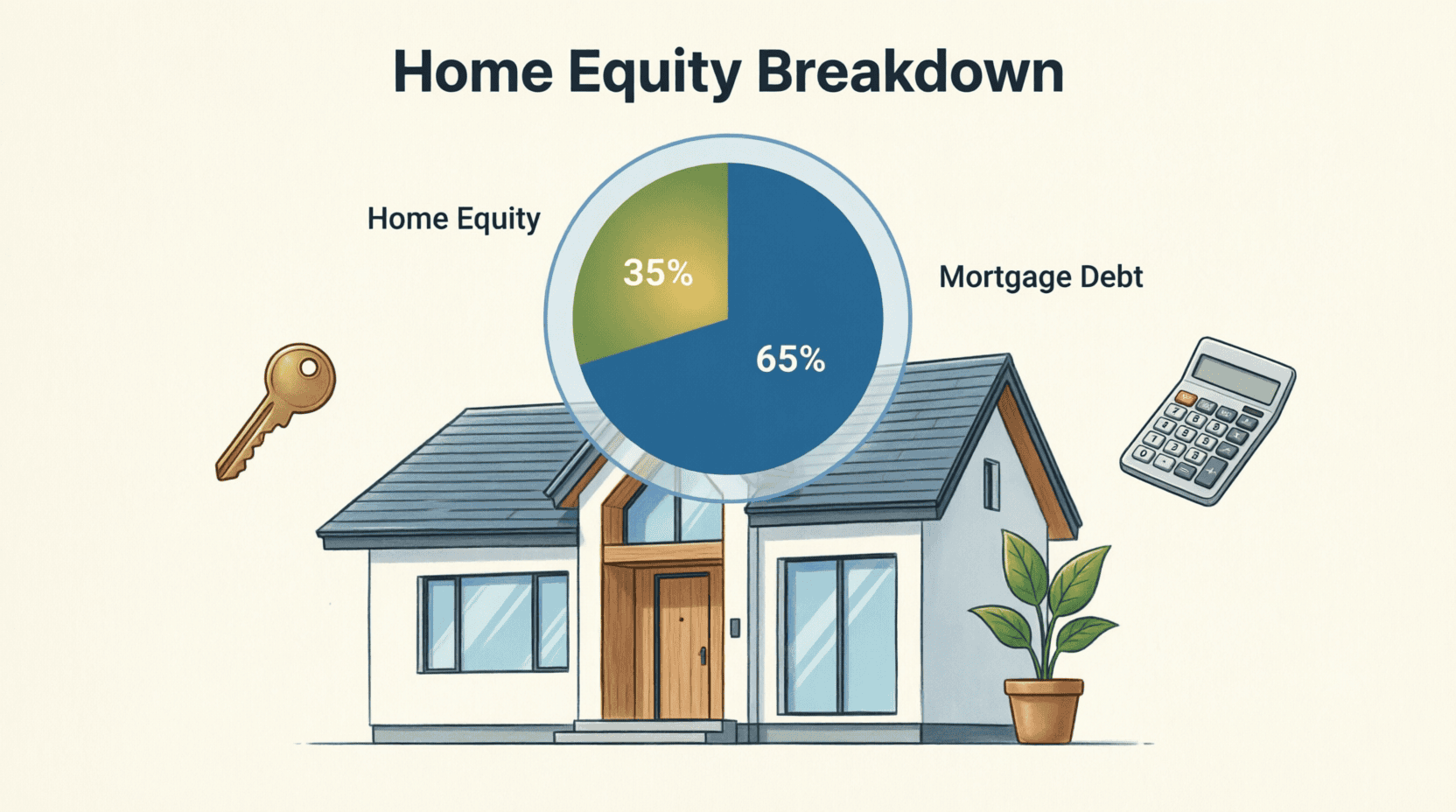
Home Equity calculator
The Home Equity Calculator shows how much of your home you actually own, free and clear of debt. Enter your home’s current estimated value and what you still owe across any mortgages or liens, and see your equity amount, your loan-to-value (LTV) ratio, and roughly how much you could borrow against your home at a typical lending limit.
Home Equity Estimator
Use a recent appraisal, a comparative market estimate, or an online valuation as your home value. Include every loan secured against the property in the balance owed.
| Current Estimated Home Value * | |
| First Mortgage Balance Owed * | Other Liens / HELOC / 2nd Mortgage Owed |
| Target Loan-to-Value for Borrowing (%) | |
Home Equity
Total debt owed is the sum of your first mortgage and any additional loans secured against the property, such as a second mortgage or HELOC.
Loan-to-Value (LTV) Ratio
LTV is the inverse view of equity — a lower LTV means more equity and typically better refinancing or borrowing terms.
Equity Percentage
Estimated Borrowable Equity
Lenders typically cap total borrowing (across all liens combined) at a maximum combined loan-to-value — often around 80% — rather than lending against 100% of your equity.
Common Uses for This Calculator
- HELOC or home equity loan applications: Estimate how much you might qualify to borrow
- Refinancing: Check whether your LTV qualifies for better refinance rates
- Selling your home: Estimate proceeds after paying off remaining mortgage balances
- Net worth tracking: Include home equity as part of your overall net worth
- Removing PMI: Many lenders drop private mortgage insurance once LTV falls to 80% or below
Worked Example
Total debt = 210,000 + 15,000 = 225,000
Home equity = 350,000 − 225,000 = 125,000
Current LTV = 225,000 ÷ 350,000 = 64.3%
Max loan at 80% LTV = 350,000 × 80% = 280,000
Additional borrowable equity = 280,000 − 225,000 = 55,000
Frequently Asked Questions
How do I estimate my home’s current value?
Common sources include a recent professional appraisal, a comparative market analysis from a real estate agent, or an automated valuation model from a listing site — each carries different accuracy, so treat online estimates as a starting point rather than a guarantee.
What counts as debt owed against the home?
Include your first mortgage balance plus any second mortgage, home equity loan, or HELOC balance secured against the same property. Unsecured debt like credit cards is not part of this calculation.
Why is the target LTV usually around 80%?
Many lenders cap combined loan-to-value at 80% for home equity products, keeping a cushion in case home values decline, though some lenders allow higher limits for well-qualified borrowers.
What does negative equity mean?
If your total debt owed is greater than your home’s current value, your equity is negative — you would owe more than the home is worth if sold today.
Does paying down my mortgage increase equity right away?
Yes, every principal payment reduces your debt owed and increases equity directly, separate from any change in the home’s market value.
Tips
- Use a realistic, current value: not the original purchase price
- Include every lien: forgetting a second mortgage overstates your equity
- Confirm with your lender: actual borrowing limits depend on more than equity alone
Understanding Home Equity
Home equity is the portion of your home you truly own — the difference between what it’s worth today and what you still owe against it. Every mortgage payment that reduces principal builds equity, and so does any rise in your home’s market value. Together, these two forces mean equity typically grows over time, even without extra payments, as long as home values hold steady or increase.
Lenders view equity through the loan-to-value ratio, comparing total debt to home value rather than looking at equity in isolation. A lower LTV signals lower risk to a lender, which is why it affects refinance rates, mortgage insurance requirements, and how much additional financing — like a HELOC or home equity loan — you may be able to secure against the property.
Who Uses This Calculator
Homeowners considering a HELOC or home equity loan, those exploring refinancing, sellers estimating proceeds, and anyone tracking net worth can use this tool to see their current equity position. It is for estimation and planning; always confirm your home’s value and borrowing limits with a lender or licensed appraiser before making financial decisions.
About This Calculator
This home equity estimator subtracts your total mortgage and lien balances from your home’s current estimated value, and projects borrowable equity at a target loan-to-value. It is intended for homeowners and buyers estimating their equity position. Figures are estimates for planning purposes only — always confirm your home’s value and any borrowing limits with a licensed appraiser or lender before making financial decisions.