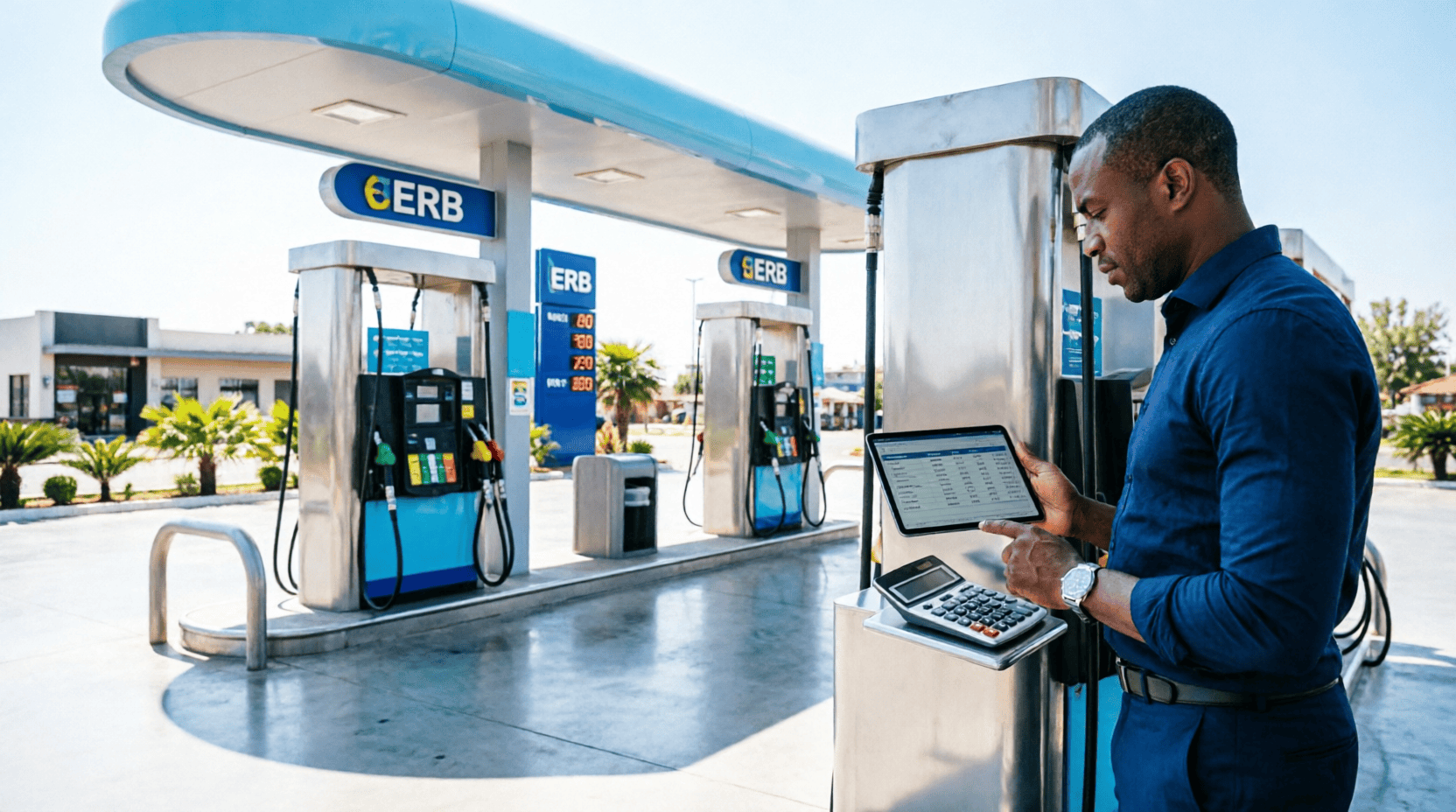
Unleaded gas petrol profit calculator
Zambia’s Premier Gas Station Profit Calculator – Calculate unleaded petrol profits in Zambian Kwacha (ZMW). Because the Energy Regulation Board (ERB) sets uniform maximum retail prices, this tool helps Zambian station owners focus on what actually drives profit: sales volume, operational efficiency, and non-fuel revenue.
Calculate gross profit. Note: ERB regulations mean wholesale and retail prices are standardized, making the profit per litre a fixed margin across all formal stations.
| Wholesale Cost (per litre) | ERB Max Retail Price (per litre) | Monthly Volume (Litres) |
| Fuel Type: (Prices are uniform across major OMCs) | ||
Since fuel margins are fixed and identical for everyone, net profit is determined entirely by how well you control Zambian operating expenses.
| Total Gross Profit (ZMW) | Monthly Operating Expenses (ZMW) |
| Typical Fixed Expenses: Staff salaries, ZEMA environmental fees, ERB licensing, ZESCO electricity, water, security, insurance, bank/POS charges (2.5-3.5%), maintenance, and ZRA taxes. | |
Determine the minimum litres of fuel you must sell monthly to cover all fixed costs. Since you cannot raise prices, hitting this volume is your primary survival metric.
| Total Monthly Fixed Expenses (ZMW) | Fixed Gross Profit per Litre (ZMW) |
The Reality of Petrol Station Profitability in Zambia
In Zambia, the fuel retail sector is strictly regulated by the Energy Regulation Board (ERB). The ERB publishes a maximum retail price for unleaded petrol and diesel every month. Because of this, all formal petrol stations sell fuel at the exact same price, and the wholesale (rack) price is also standardized.
This means the gross profit margin per litre is fixed and identical for everyone. You cannot increase your fuel profits by raising prices. Therefore, profitability in the Zambian fuel sector depends entirely on three things: maximizing sales volume, ruthlessly controlling operating expenses, and generating non-fuel revenue (e.g., convenience stores, car washes, and airtime).
1. Calculating Gross Profit (The Fixed Margin)
Since prices are uniform, your gross profit is simply the ERB-regulated spread multiplied by your volume. There is no pricing strategy to improve this number; only volume strategy.
2. Net Profit: Where the Real Battle is Fought
Because the top-line margin is fixed, your net profit is determined entirely by how efficiently you manage your Zambian operating expenses. A station that spends ZMW 80,000 on overhead will be highly profitable, while an identical station spending ZMW 110,000 will operate at a loss.
Major Operating Expenses for Zambian Petrol Stations:
- Staff Costs: Station manager, pump attendants, and security guards (often the largest controllable expense).
- Financial Charges: Credit/debit card and POS processing fees (2.5% – 3.5% per transaction). This is a massive profit killer in Zambia’s increasingly cashless market.
- Utilities: ZESCO electricity for pumps, canopy lights, and shop refrigeration, plus water bills.
- Regulatory Compliance: ZEMA environmental fees, ERB annual licensing, local council levies, and weights & measures pump calibration.
- Insurance & Maintenance: Public liability, fire insurance, tank cleaning, and generator maintenance (crucial due to load-shedding).
- Shrinkage: Fuel theft, meter inaccuracies, or temperature-related volume loss (can account for 1-2% of total volume).
3. Break-Even Analysis for Zambia
The break-even point tells you the exact minimum litres you must sell monthly just to cover your fixed costs, resulting in ZMW 0 net profit. Because you cannot raise prices to lower this threshold, your only lever is to reduce fixed expenses or negotiate a slightly better wholesale rebate from your Oil Marketing Company (OMC).
How to Actually Increase Profits in Zambia (Since Prices are Fixed)
- Maximize Non-Fuel Revenue: This is the secret to Zambian petrol station wealth. Margins on shop items (bread, cold drinks, cooking oil, airtime) are 20-40%, compared to the 6-8% fuel margin. A busy shop subsidizes the fuel business.
- Add a Car Wash or Quick Service Restaurant (QSR): These services have high margins and keep customers on your premises longer, increasing the chance of shop sales.
- Negotiate Volume Rebates with OMCs: While the base wholesale price is fixed, major OMCs (TotalEnergies, Vivo Energy/Shell, Puma, Go Oil) may offer backend volume rebates or marketing support if you consistently hit high litre targets.
- Invest in Solar Power: With ZESCO load-shedding, running a diesel generator for canopy lights and shop fridges is expensive. Solar can save ZMW 3,000 – ZMW 6,000 per month.
- Strict Shrinkage Control: Implement strict dip-testing procedures, calibrate pumps regularly, and monitor staff to prevent the 1-2% inventory loss that destroys thin margins.
Regulatory Compliance Checklist for Zambia
Operating legally is non-negotiable. Ensure you have up-to-date:
- ERB License: Annual renewable license from the Energy Regulation Board.
- ZEMA Approval: Environmental Impact Assessment (EIA) and annual environmental management fees.
- PACRA Registration: Valid business registration.
- ZRA TPIN: For VAT, PAYE, and corporate tax compliance.
- Local Council Permit: Annual operating permit from the city or municipal council.
- FIRPS Certification: Fire Insurance and Risk Prevention Services compliance.
- Weights & Measures: Annual pump calibration certification from the relevant government department.
Frequently Asked Questions – Zambia Context
Why are all petrol station prices the same in Zambia?
The Energy Regulation Board (ERB) sets a maximum retail price every month based on the import parity price (crude oil costs, USD/ZMW exchange rate, and transport from Dar es Salaam/Durban). Formal stations price at or very near this maximum because the regulated margin is thin, and pricing lower unnecessarily sacrifices already small profits.
What is the average net profit margin for a Zambian petrol station?
For fuel sales alone, net profit margins are typically very thin, ranging from 1% to 3% after all expenses. However, stations with well-managed convenience stores, car washes, or QSRs can achieve an overall business net margin of 8% to 15%.
How many litres must I sell monthly to be profitable?
A typical urban station in Lusaka, Ndola, or Kitwe needs to sell 50,000 to 80,000 litres/month (1,600 – 2,600 litres/day) to comfortably cover higher urban rents, salaries, and security costs. Rural stations can be profitable on 20,000 – 30,000 litres/month due to significantly lower overheads.
Should I franchise with a major brand or operate as an independent “white pump”?
Franchise (Total, Shell, Puma): Pros: Guaranteed fuel supply, strong customer trust, marketing support, standardized training. Cons: Strict operational rules, potential franchise fees, less flexibility.
Independent: Pros: Lower overhead, flexibility to run aggressive shop promotions. Cons: Supply insecurity during national shortages, lower customer trust, harder to get favorable bank POS rates.
Verdict: For new investors, franchising is generally safer due to supply chain reliability.
Disclaimer: This calculator is for estimation and business planning purposes only. Actual profitability depends on location, management efficiency, and monthly ERB price adjustments. The ERB updates maximum retail prices monthly based on global oil markets and the Bank of Zambia exchange rates. Always consult with a qualified Zambian accountant and the ERB for precise financial and regulatory guidance.
Last Updated: 2024/2025 | Data Sources: Energy Regulation Board (ERB) Zambia, Bank of Zambia, Zambia Statistics Agency (ZamStats)