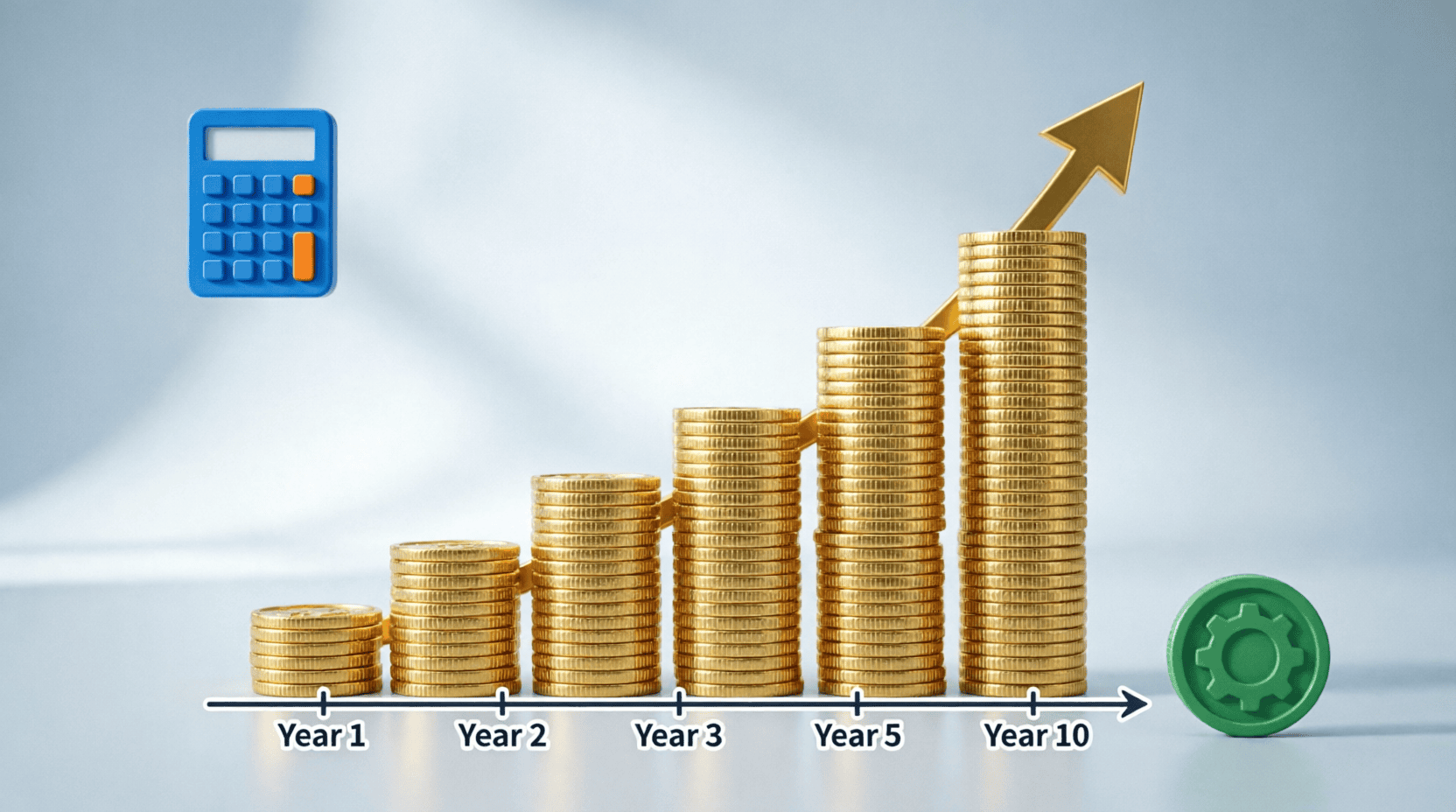
Future Value of Annuity Calculator
The Future Value of Annuity Calculator answers a different question than most annuity tools: instead of asking what future payments are worth today, it asks what your own regular contributions will have grown into by a future date. Enter how much you plan to contribute each period, your expected rate of return, and how many periods you’ll keep contributing, and see the balance you’d be sitting on when the last contribution lands.
Future Value of Annuity Estimator
Rate and number of periods must be in matching units — a monthly contribution needs a monthly rate and a period count in months.
| Contribution Amount per Period * | |
| Expected Rate of Return per Period (%) * | Number of Periods * |
| Contribution Timing * | |
How Sensitive Is This to Your Rate Assumption?
Using your contribution amount and number of periods above, here’s how the final value shifts across three different rate-per-period assumptions — useful since small rate differences compound into large gaps over long horizons.
| Scenario | Rate per Period | Future Value |
|---|---|---|
| Enter your contribution and number of periods above to see this comparison. | ||
Two people can make the exact same monthly contribution at the exact same rate of return and end up with wildly different results, for one reason alone: when they started. That’s the single most important thing this calculator makes visible, and it’s worth walking through in full before looking at the formula itself.
Saver A: Starts at 30
Contributes 250 a month to a retirement account starting at age 30, earning an average 7% annual return (≈0.583% monthly), at the end of each month, for 35 years until retiring at 65 — 420 contributions total.
Total contributed = 250 × 420 = 105,000
Growth from compounding ≈ 345,264
Saver B: Starts at 40
Contributes the same 250 a month, at the same 7% return, but doesn’t start until age 40 — leaving only 25 years (300 months) before retiring at 65.
Total contributed = 250 × 300 = 75,000
The Gap
Saver B contributed only 30,000 less in total than Saver A, but retires with roughly 247,700 less — well over half the final balance, wiped out by ten fewer years of compounding. That gap is not about how much either person saved; it’s almost entirely about time. This is why “start early, even with small amounts” tends to beat “wait and start bigger later” in nearly every realistic scenario.
Where Else This Applies
- 401(k) or pension projections — estimate a balance from steady payroll contributions
- College savings plans — project a fund from consistent monthly deposits
- Sinking funds — plan how scheduled deposits accumulate toward a known future cost
- Business cash reserves — model how regular set-asides build a reserve over time
Ordinary Annuity (contribution at end of period)
Here PMT is what you contribute each period, r is the rate of return per period, and n is the total number of contributions. This is structurally the mirror image of the present-value annuity formula — instead of shrinking future amounts back to today, it grows a stream of regular deposits forward to a future date.
Annuity Due (contribution at start of period)
If you contribute at the beginning of each period rather than the end, every deposit earns one extra period of compounding, which is why the annuity-due version is always slightly larger.
Special Case: Zero Rate of Return
With a 0% rate of return, there’s no compounding at all — the future value simply equals PMT × n, the sum of every contribution with nothing added on top.
Frequently Asked Questions
How is this different from a present value of annuity calculator?
Present value asks what a future stream of payments is worth today, discounting them backward. Future value asks the opposite: what will a stream of contributions you make starting now be worth at a future date, compounding them forward. They use mirrored versions of the same formula.
Should I use end-of-period or start-of-period timing?
Most payroll-deducted retirement contributions and automatic monthly transfers land at the end of the period they cover, so ordinary annuity (end of period) is the more common choice unless you know your contributions are deducted in advance.
What rate of return should I assume?
This depends heavily on what you’re invested in — conservative savings accounts, bonds, and diversified stock portfolios have very different historical average returns. Many long-term retirement projections use a range around 5–8% annually as a planning assumption, not a promise.
Does this account for contribution increases over time?
No — this calculator assumes a fixed contribution amount every period. If you plan to increase contributions annually (common with employer retirement plans that auto-escalate), the actual future value will be higher than shown here.
Can I model an initial lump sum plus ongoing contributions?
Not directly in this tool — it calculates the future value of the recurring contributions only. To include an existing starting balance, you’d need to separately grow that lump sum forward and add it to this result.
Tips
- Match your rate and period units: monthly contributions need a monthly rate
- Use a conservative return assumption: for long horizons, avoid overly optimistic rates
- Remember it excludes taxes and fees: account fees and taxes on withdrawal can reduce the real amount available
Understanding Future Value of an Annuity
Future value of an annuity measures what a series of equal, regular contributions grows into after compounding over time. Unlike a single lump-sum deposit, each contribution in the series starts compounding from its own date — the first contribution has the longest time to grow, while the very last contribution barely compounds at all. Adding up the future value of every individual contribution is exactly what the annuity formula does in one step.
This calculation sits at the center of most retirement and savings planning. It explains why starting earlier matters more than contributing more — an early contribution has decades to compound, while a late one, however large, has far less time working in its favor. It also pairs naturally with a present value of annuity calculation: one tool projects contributions forward to a future goal, the other discounts a future payment stream back to today’s terms.
Who Uses This Calculator
Anyone planning regular retirement contributions, building a college fund, saving toward a future purchase through consistent deposits, or comparing “start early vs. start big” savings strategies can use this tool to see a concrete projected balance. It is for estimation and planning; actual investment returns vary, and this figure should not be treated as a guaranteed outcome.
About This Calculator
This future value of annuity estimator projects the growth of a fixed recurring contribution across a chosen number of periods and rate of return, supporting both end-of-period and start-of-period timing. It is intended for individuals and students projecting long-term savings or retirement contribution outcomes. Figures are estimates for planning purposes only — actual returns, contribution schedules, taxes, and fees will affect real-world results, so consult a licensed financial advisor for personalized planning.