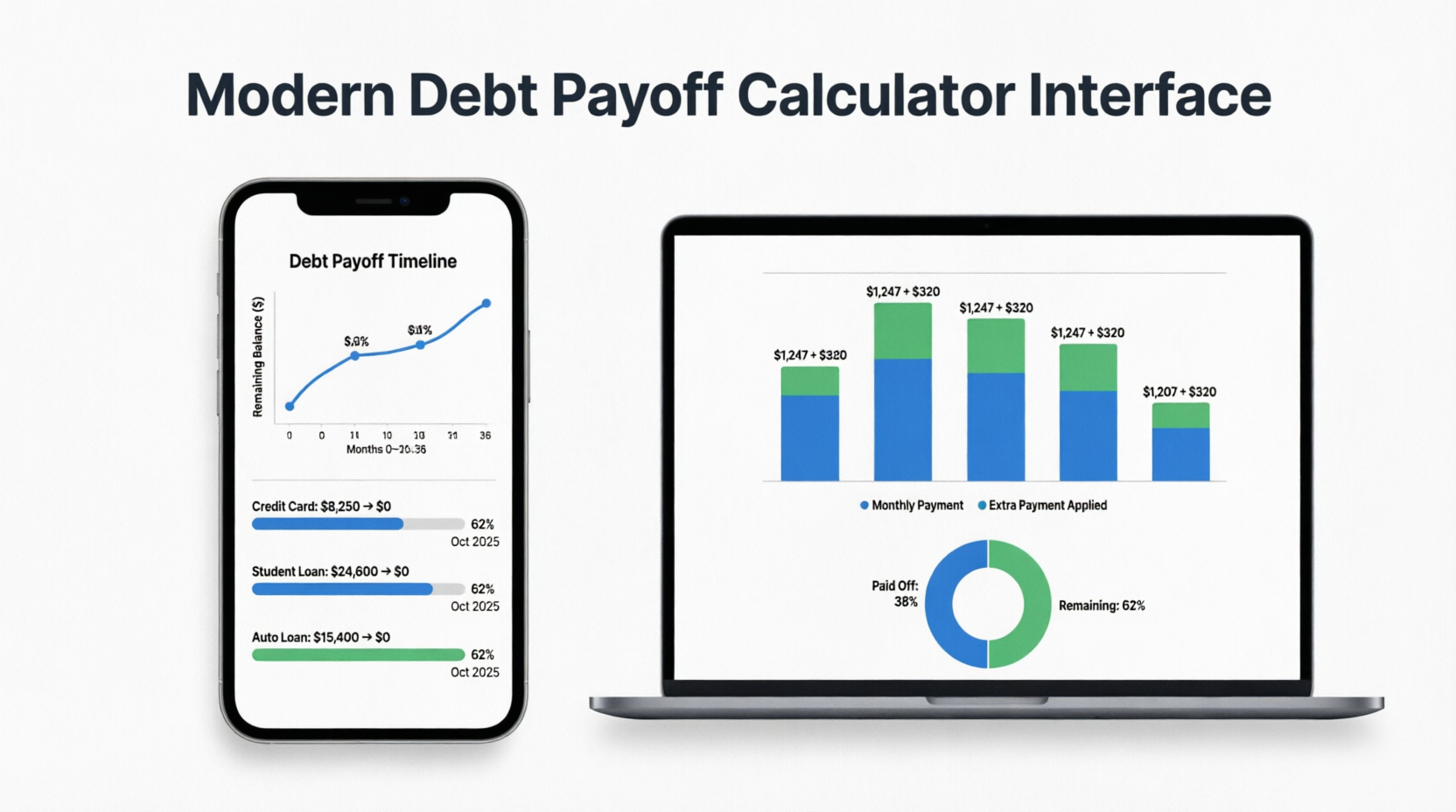
Debt payoff Calculator
The Debt Payoff Calculator helps you create a personalized debt elimination strategy and calculate how long it will take to become debt-free. By entering your debt amounts, interest rates, and payment amounts, you can compare different payoff methods (snowball vs. avalanche), understand the true cost of debt, and create a motivating roadmap to financial freedom. This tool is essential for anyone committed to eliminating debt and building financial security. Always seek professional financial advice for complex debt situations.
Debt Payoff Calculator
Calculate payoff timeline for a single debt with your planned monthly payment.
| Debt Balance (ZMW) | Interest Rate (%) | Monthly Payment (ZMW) | Debt Type |
Calculate payoff timeline for multiple debts using snowball or avalanche methods.
| Total Monthly Payment (ZMW) | Payoff Strategy |
Your Debts
| Debt 1: Credit Card | |||
| Balance (ZMW) | Interest Rate (%) | Min Payment (ZMW) | Type |
| Debt 2: Personal Loan | |||
| Balance (ZMW) | Interest Rate (%) | Min Payment (ZMW) | Type |
| Debt 3: Car Loan | |||
| Balance (ZMW) | Interest Rate (%) | Min Payment (ZMW) | Type |
Compare snowball vs. avalanche methods to find the best debt elimination strategy for you.
| Total Debt (ZMW) | Average Interest Rate (%) | Monthly Payment (ZMW) |
Understanding Debt and Payoff Strategies
Debt is borrowed money that must be repaid with interest. While strategic use of debt can help you achieve goals (home ownership, education), excessive debt creates financial stress and limits your future choices. Understanding your debt, creating a payoff strategy, and following through systematically is essential for achieving financial freedom. For comprehensive financial planning, explore our Family Budget Calculator, Savings Calculator, and Compound Interest Calculator to build a complete financial plan that supports debt elimination.
Types of Debt
Different types of debt carry different interest rates and repayment terms. Understanding your debt profile helps you prioritize payoff strategies:
| Debt Type | Typical Interest Rate | Term | Characteristics |
|---|---|---|---|
| Credit Card Debt | 15-25% | Variable (Minimum payments) | Unsecured, high interest, revolving credit |
| Personal Loan | 10-20% | 2-7 years | Unsecured, fixed payments, fixed term |
| Car Loan | 5-10% | 3-6 years | Secured (vehicle collateral), fixed payments |
| Student Loan | 4-8% | 10-25 years | Federal or private, flexible repayment options |
| Mortgage | 3-7% | 15-30 years | Secured (property), lowest rates, long term |
The Debt Snowball Method
The debt snowball method focuses on paying off the smallest debt first while making minimum payments on larger debts. Once the smallest debt is eliminated, you “roll” that payment into the next smallest debt, creating momentum. This psychological approach provides quick wins and motivation to continue paying off debt. The snowball method works best for people who are motivated by seeing debts disappear quickly and need encouragement to stay committed to their payoff plan.
Debt 1: Credit card balance ZMW 5,000 at 20% interest
Debt 2: Personal loan balance ZMW 15,000 at 15% interest
Debt 3: Car loan balance ZMW 25,000 at 10% interest
Snowball Strategy:
Month 1-3: Pay extra on Debt 1 (credit card) → Eliminate it → Free up cash flow
Month 4+: Apply that payment to Debt 2 (personal loan) → Faster payoff
Once Debt 2 eliminated: Apply all payments to Debt 3 (car loan)
Result: Psychological motivation from quick wins; may pay more total interest
The Debt Avalanche Method
The debt avalanche method prioritizes paying off debts with the highest interest rates first, regardless of balance. While the smallest debt may not disappear as quickly, this mathematically optimal approach minimizes total interest paid over time. The avalanche method appeals to people motivated by saving money and those comfortable with delayed gratification in exchange for financial efficiency.
Debt 1: Credit card balance ZMW 5,000 at 20% interest ← HIGHEST RATE
Debt 2: Personal loan balance ZMW 15,000 at 15% interest
Debt 3: Car loan balance ZMW 25,000 at 10% interest
Avalanche Strategy:
Month 1+: Pay extra on Debt 1 (credit card) → Eliminate highest interest
Then: Focus on Debt 2 (personal loan)
Finally: Pay off Debt 3 (car loan)
Result: Minimize total interest paid; may take longer for first payoff
Comparing Snowball vs. Avalanche Methods
| Aspect | Debt Snowball | Debt Avalanche |
|---|---|---|
| Target Focus | Smallest balance first | Highest interest rate first |
| Total Interest Paid | Higher (less optimal) | Lower (more optimal) |
| Payoff Timeline | Similar to avalanche | Similar to snowball |
| Psychological Benefit | Quick wins, high motivation | Long-term savings appeal |
| Best For | People needing motivation and wins | Financially motivated individuals |
Strategies to Accelerate Debt Payoff
1. Increase Your Monthly Payment
Even small increases to your monthly payment can significantly reduce payoff time and total interest. For example, increasing from ZMW 2,000 to ZMW 2,500 monthly can save thousands in interest and eliminate debt months earlier.
2. Use Windfalls for Debt Payoff
Direct bonuses, tax refunds, inheritance, or gifts directly to debt elimination rather than lifestyle spending. This accelerates payoff without impacting your regular budget.
3. Consolidate High-Interest Debt
Combining multiple high-interest debts into a single lower-interest loan can reduce total interest paid. Compare consolidation options carefully, as some fees may offset savings.
4. Negotiate Lower Interest Rates
Contact creditors to negotiate lower rates based on improved payment history or credit score. Even 1-2% reduction saves significant money over time.
5. Cut Expenses to Free Up Cash
Review your budget and identify non-essential spending. Redirect savings to debt payoff. Small cuts (subscriptions, dining out) compound into substantial extra payments.
Benefits of Becoming Debt-Free
- Improved credit score and creditworthiness
- Higher approval rates and better terms for future borrowing
- Reduced financial stress and anxiety
- More disposable income for savings and goals
- Improved ability to handle emergencies
- Freedom to pursue career changes or new opportunities
- Better relationships with family (reduced money stress)
- Increased sense of control and financial security
- Ability to invest and build wealth
- Peace of mind and improved overall well-being
Avoiding Debt Traps
- Only making minimum payments: Keeps you in debt for decades; pay extra when possible
- Taking on new debt while paying off old debt: Defeats payoff progress; cut spending instead
- Accumulating high-interest payday loans: Interest rates can exceed 400% APR; consider alternatives
- Using credit for discretionary spending: Creates unnecessary debt that takes months to pay off
- Avoiding the debt entirely: Ignoring debt doesn’t solve it; facing it directly is necessary
- Comparing your progress to others: Focus on your own timeline and strategy
- Giving up during difficult months: Stay committed; small steps compound into freedom
Frequently Asked Questions
Which method is better—snowball or avalanche?
The best method is the one you’ll actually follow. Snowball offers psychological motivation through quick wins; avalanche saves more money mathematically. Choose based on what keeps you committed to your payoff plan.
How do I stay motivated during debt payoff?
Track progress monthly, celebrate milestones, visualize your debt-free future, focus on the benefits of freedom, and consider using accountability partners or support groups. Consistent progress builds momentum.
What if I can’t afford extra payments?
Start by making regular on-time payments. Once your budget allows, even ZMW 100 extra monthly accelerates payoff. Focus on cutting expenses where possible to free up cash.
Should I use savings to pay off debt?
Generally, prioritize building a small emergency fund (ZMW 1,000-2,000) first, then direct excess savings to debt payoff. This prevents new debt if emergencies occur.
Can I negotiate my debt balance?
Sometimes, creditors may accept a settlement for less than owed, especially if you’re behind on payments. However, this damages credit. Negotiate carefully and understand tax implications.
How long does it take to recover from debt?
Recovery time depends on debt amount, payment size, and interest rates. With consistent payments, most people eliminate consumer debt in 2-7 years. Bankruptcy recovery takes 7-10 years.
Disclaimer: This Debt Payoff Calculator provides estimates based on standard debt payoff calculations. Individual situations vary based on interest rates, payment amounts, debt types, and financial circumstances. These calculations should not replace professional financial or credit counseling. Consult with a certified financial planner, credit counselor, or debt advisor for personalized guidance on your specific debt situation.