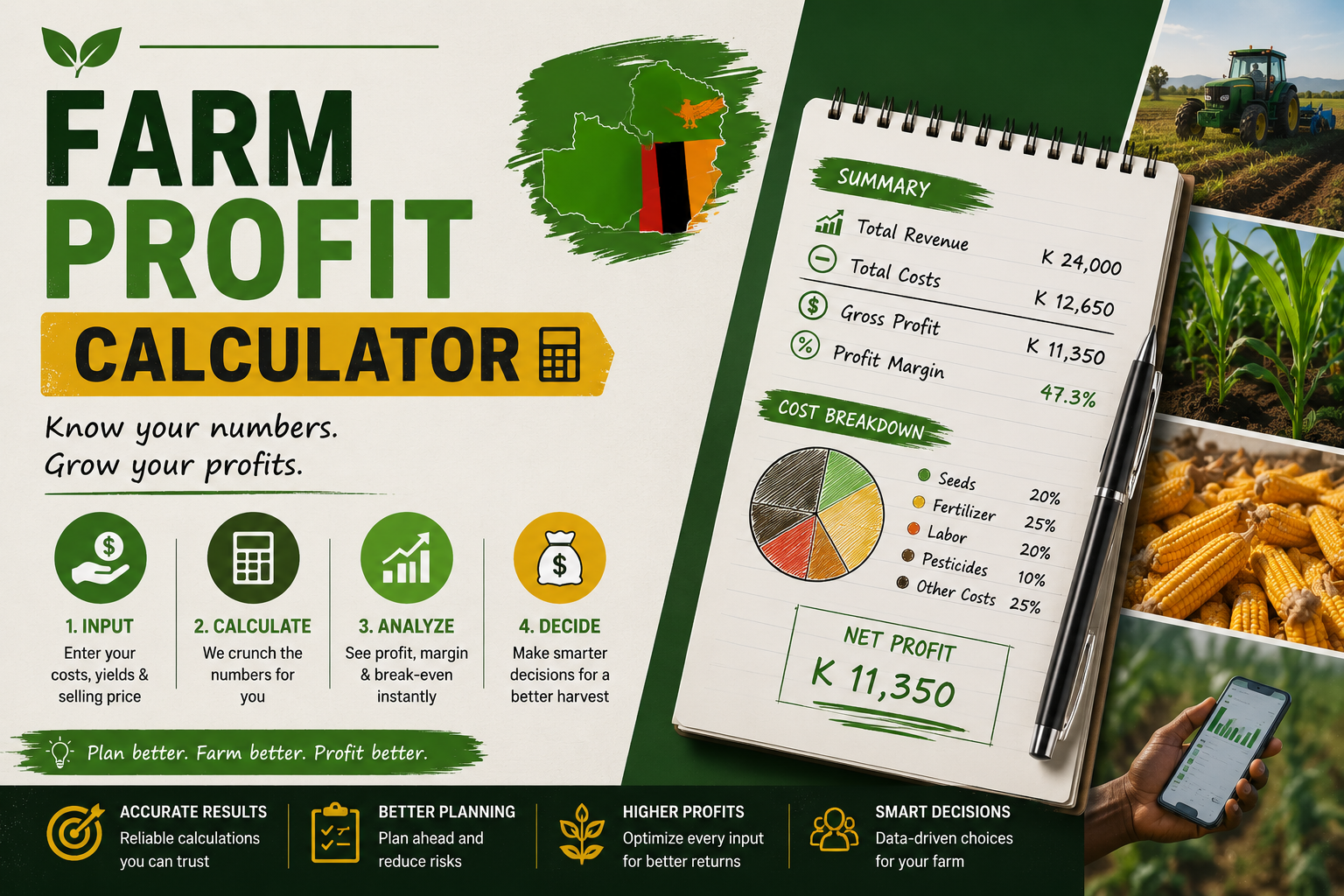
Zambia Farm Profit Calculator
The Zambia Farm Profit Calculator estimates your expected revenue, total production costs, and net profit per growing season for any crop. Enter your land size, expected yield, and selling price, then add your input costs (seed, fertiliser, labour, transport, and others) to see your profit margin and break-even yield. Works for maize, soybeans, groundnuts, tomatoes, and any other crop grown in Zambia.
Farm Profit Calculator
Crop & Yield Details
| Crop / Enterprise Name | Land Size (hectares) | Expected Yield (per hectare) |
| Yield Unit | Selling Price per Unit (ZMW) | Currency |
Production Costs (per total land size)
| Total Revenue | K0.00 |
| Total Production Costs | −K0.00 |
| Net Profit / Loss | K0.00 |
| Profit Margin | 0% |
| Profit per Hectare | K0.00 |
| Break-Even Yield (per hectare) | 0 |
About This Calculator
Farming decisions in Zambia — whether for maize on a small plot in Copperbelt or tomatoes under irrigation on the Lusaka outskirts — depend on knowing your numbers before you plant. This calculator brings together your expected yield, selling price, and all production costs into one clear profit summary, so you can compare different crops, inputs, or farming seasons before committing your money.
How Farm Profit Is Calculated
Total Costs = Sum of all cost items entered
Net Profit = Total Revenue − Total Costs
Profit Margin = (Net Profit ÷ Total Revenue) × 100
Break-Even Yield per Hectare = Total Costs ÷ (Selling Price × Land Size)
Break-even yield tells you the minimum harvest you need, per hectare, to avoid a loss at your chosen selling price. If your expected yield is below the break-even point, the crop will lose money at that price — useful information before investing in seed and fertiliser.
Common Cost Items to Include
Production costs vary by crop and farming method, but typically include:
- Seed or seedlings
- Fertiliser (basal and top dressing) and lime
- Pesticides, herbicides, and fungicides
- Labour (land preparation, planting, weeding, harvesting)
- Land preparation / ploughing costs (tractor or oxen hire)
- Irrigation costs (fuel for pumps, water charges)
- Transport to market or buyer
- Storage, bags, and packaging
- Land rent, if applicable
Use the “Add Cost Item” button to list each of these separately — this also makes it easy to see which cost is eating most of your margin.
Typical Zambian Crop Yields (Indicative)
| Crop | Typical Yield per Hectare (Smallholder) | Typical Yield per Hectare (Commercial/Irrigated) |
|---|---|---|
| Maize | 20–35 bags (50kg) | 60–120 bags (50kg) |
| Soybeans | 10–20 bags (50kg) | 30–50 bags (50kg) |
| Groundnuts | 8–15 bags (50kg) | 20–35 bags (50kg) |
| Tomatoes | Varies widely by variety & irrigation | Significantly higher under drip irrigation |
These figures are indicative only and vary by soil fertility, rainfall, variety, and farming practice. Use your own farm records or extension officer guidance for the most accurate yield estimate for your land.
Worked Example: One Hectare of Maize in Zambia
A smallholder farmer in Mpongwe plants 1 hectare of maize, expecting a yield of 35 bags (50kg) per hectare, and plans to sell at K280 per bag shortly after harvest:
| Cost Item | Amount (ZMW) |
|---|---|
| Seed | K800 |
| Fertiliser (Basal + Top Dressing) | K3,500 |
| Labour | K1,500 |
| Land Preparation | K700 |
| Transport | K400 |
Total Revenue = 35 bags × K280 = K9,800.00
Total Costs = K800 + K3,500 + K1,500 + K700 + K400 = K6,900.00
Net Profit = K9,800 − K6,900 = K2,900.00
Profit Margin = (K2,900 ÷ K9,800) × 100 = 29.6%
Break-Even Yield = K6,900 ÷ (K280 × 1 ha) = 24.6 bags per hectare
In this example, the farmer needs at least 24.6 bags per hectare just to break even — anything harvested above that, up to the expected 35 bags, becomes profit. A poor season yielding only 20 bags would result in a loss at this selling price, which is exactly the kind of risk this calculator helps you see in advance, before you commit to inputs.
Why Profit Margin Varies So Much Between Seasons
Two farmers with identical yields can end a season with very different profit outcomes, mainly because of three swing factors:
- Input costs — fertiliser and seed prices in Zambia can shift significantly between planting seasons depending on import costs, subsidy programmes (such as the Farmer Input Support Programme), and Kwacha exchange rate movements.
- Selling price timing — prices are typically lowest right after harvest when supply is highest, and rise during the lean season. Farmers who can store their crop and sell later often capture a meaningfully better price, at the cost of storage risk and capital tied up.
- Yield variability — rainfall, pest pressure (such as fall armyworm in maize), and soil fertility all affect actual yield versus the planned figure, which is why running this calculator at a conservative, expected, and optimistic yield gives a more realistic profit range than a single estimate.
Using This Calculator for Loan or Input Financing Decisions
Many Zambian farmers access inputs through cooperatives, agro-dealers, or seasonal loans that must be repaid after harvest. Before taking on input financing, it’s worth running the numbers here with your loan repayment included as a cost item, so the break-even yield reflects the true cost of borrowed capital, not just cash costs. If the resulting break-even yield is close to or above your realistic expected yield, that signals the financing terms may leave little or no margin in a normal season — useful information to raise with the lender or cooperative before signing.
Frequently Asked Questions
What if I farm more than one crop on the same land?
Run the calculator separately for each crop using its own land size, yield, and costs, then compare the profit summaries side by side.
Should I include my own labour as a cost?
It’s good practice to include the value of your own labour (and family labour) as a cost item, even if you’re not paying cash wages, since it gives a more realistic picture of whether the enterprise is genuinely profitable.
What is break-even yield and why does it matter?
Break-even yield is the minimum harvest per hectare needed to cover your costs at your chosen selling price. If your expected yield is close to or below this figure, the crop carries a real risk of making a loss in that season.
Does this calculator account for transport and storage losses?
Not automatically — you should reduce your expected yield input to reflect anticipated post-harvest losses (spoilage, pest damage, shrinkage), and add transport and storage costs as separate cost items.
Can I use this for livestock or poultry instead of crops?
Yes, the same structure works: treat “yield” as number of birds/animals sold, “selling price” as price per bird/animal, and list feed, day-old chicks or stock, vaccines, and labour as cost items.
How do I factor in a seasonal input loan?
Add your expected loan repayment amount, including interest, as its own cost item. This raises your total costs and break-even yield to reflect the real cost of financed inputs, giving a more honest profit picture than ignoring the loan.
Why does selling immediately after harvest often give a lower price?
Crop supply is highest right after harvest as most farmers sell at the same time, which typically pushes prices down. Prices tend to recover later in the season as supply tightens, though storing crop to wait for better prices carries its own costs and risks.